Student Handbook

Coe College Student Handbook

Revised January 2026

Welcome to Coe College

Coe College is a national, residential liberal arts college offering a broad array of programs in the arts, sciences and professions. Our mission is to prepare students for meaningful lives and fulfilling careers in a diverse, interconnected world. Coe's success will be judged by the success of our graduates.
 
A liberal arts education is the best preparation for life. We believe that such an education allows students to discover what their real talents and interests are, and that it develops in them the skills, abilities and habits of mind that will make possible a successful career in any field of endeavor, including ones that do not yet exist. Furthermore, we believe that it is important for a liberal arts education to cultivate in students a desire to understand, a capacity for tolerance, and an ability to appreciate the ethnic and cultural diversity that make up humankind. It is the mission of the College to develop in students these abilities and attitudes, and in so doing, to provide them an education that directs them toward a meaningful and successful life.
 
Coe College does not discriminate on the basis of race, color, religion, sex, pregnancy, national origin, age, disability, veteran status, sexual orientation, gender identity or genetic information in its programs and activities.

This statement was written by students in order to address standards of civility and respect within the Coe College community; meaning that Coe students are committed to respecting one another and allowing all individuals to be heard and encouraged, while practicing effective communication, honesty, and empathy. Coe College students wish to promote these core values to ensure a safe and judgment free environment.  This statement is a living document and is intended to evolve over time.
 
We, the members of the Coe College community, expect our campus climate to be safe, mutually supportive, academically encouraging, equitable, and accepting of all its members.
 
In addition:
  • We acknowledge and encourage the academic experience to extend beyond the classroom and into our living and social environment, where all persons can work and learn together to promote high-level collaboration.
  • We expect a campus free of incidents that create a hostile environment.
  • We expect a healthy and responsible attitude to accompany all classes, programs, social gatherings, etc.
  • Intoxication will not be an excuse for inappropriate behavior or policy violations that occur while under the influence.
  • We expect that diversity of opinion will be encouraged and respected with honor and dignity; students should be able to disagree without being disagreeable.
  • Everyone has the right to be respected for their individuality.
  • The members of our campus community shall respect the rights of other persons, including, but not limited to, regard to their actual or perceived age, color, creed, disability, neurodiversity, gender identity, gender expression, national origin, race, religion, sex, pregnancy, or sexual orientation.
  • The Coe community is made up of individuals who model these standards and hold each other accountable. In order for the community to encompass the goals outlined above, each individual is responsible and accountable for their own actions and words, and should use this document as a guideline.

Coe College Code of Conduct

This document contains expectations, policies, and resources specific to students at Coe College. 
 
No handbook can anticipate every circumstance or question regarding college policies. Accordingly, this document does not create a contract between any student and Coe College or its employees. Coe College reserves the right to modify, change, update, revise, or rescind this document at any time, without notice, as it deems appropriate based on the facts and circumstances surrounding each situation. The contents of this handbook supersede and revoke all prior statements of policy at Coe College contained in student handbooks from previous years. The Student Handbook was most recently updated in August 2025.
 
Upon admittance to Coe College and receipt of a student enrollment fee, students accept the responsibility to observe all Coe College expectations, policies, and regulations. Should an individual violate Coe College expectations, policies, or regulations after their admittance to the College and payment of a student enrollment fee, but prior to the start of their first enrolled semester, the admitted individual may be subject to an educational conversation, be placed on disciplinary warning, be placed on disciplinary probation, have their admission revoked at the discretion of professional staff in the Office of Admission and Office of Student Life, or other appropriate measures. Among other factors, professional staff will consider the severity of the reported behavior and whether the reported behavior requires intervention to safeguard the health, safety, or welfare of the Coe College community when determining an appropriate response. 
 
Expectations and policies within this Student Handbook apply to all students, student groups, student organizations, and athletic teams. Alleged violations of Coe College expectations, policies, and regulations by students (except for academic regulations, hazing related incidents, and alleged sexual misconduct under the Coe College Title IX Sexual Misconduct Policy) shall be subject to and are within the scope of the Student Conduct Process described in this handbook. Students who engage in sexual misconduct, as defined by Title IX, shall be subject to the resolution processes listed in the Coe College Title IX Sexual Misconduct Policy, which can be found in its entirety by visiting the Coe College Title IX webpage.
 
In addition to the student-specific policies found in this Student Handbook, Coe College students are expected to observe all policies found in the Staff Policy Handbook and Faculty Handbook. Alleged violations of the College & Employment Policies by students shall be subject to and are within the scope of the Student Conduct Process. The College & Employment Policies apply to all faculty, staff, and students at Coe College.  The College & Employment Policies can be found on the Coe College website.
 
Finally, Coe College students are responsible for adhering to all local, state, and federal laws. Coe College will not and cannot protect students from the consequences of violating these statutes. Student behavior that violates local, state, and federal laws (on- or off-campus) is within the scope of the Student Conduct Process described in this handbook. 
 
The mission of Student Conduct is to educate students about policies and civility as they examine the intentions and impacts of their behaviors and decision making.  The conduct process focuses on accountability, and is educational in nature, to aid in student development and enhance the student experience.  The student conduct process engages students with intentional conversation surrounding expectations and policies.
 
Creating a safe, inclusive, and vibrant campus community is the work of all Kohawks. It is our hope that the expectations and policies found within the Coe College Code of Conduct empower each member of our student community to help create such an environment. Further, we aim for the Student Conduct Process to provide an educational, equitable, and student-centered approach to resolve violations of expectations and policies.

All students are expected to practice:
  • Respect & Civility: Respect the rights of other persons regardless of their race, color, religion, sex, pregnancy, national origin, age, disability, veteran status, sexual orientation, gender identity, or genetic information.
  • Support & Care: Support the Coe community; foster wellbeing, practice bystander intervention, and promote and utilize campus resources.
  • Responsibility & Accountability: Model the expectations of the college while striving to meet the standard of accountability referenced in the Coe College Code of Conduct.

The process and personnel responsible for administering the expectations and policies contained in this document are housed within the Office of Student Life and include, but are not limited to: The Dean of Student Life and Co-Curricular Programs, the Assistant Dean of Students, the Director of Campus Life, the Director of Residence Life, and Residence Life staff.

The standard of proof used in the student conduct process is a preponderance of evidence; meaning the available information supports a finding that it is more likely than not a violation of policy occurred.

  1. Administrative Conduct Board Chairperson: Individual responsible for facilitating and evaluating all components of the administrative conduct board hearing.
  2. Administrative Conduct Board Committee: Trained members of the faculty and staff, as well as trained student panelists that hear and make decisions in the administrative conduct hearing
  3. Appeal: Requested re-evaluation of an outcome.
  4. Appeal Officer: Person authorized to review written appeals submitted by students who are found responsible for (a) policy violation(s). An Appeal Officer has the right to determine whether or not a written appeal satisfies the appropriate grounds for appeal.
  5. Business Days: Days the college is open; typically, Monday - Friday, excluding college holidays.  The College continues to operate its business during periods of time when students are not in session, including summer break or a portion of winter break.
  6. College: Refers to Coe College and all related entities.
  7. College Official: Administrator at the College including but not limited to President, Dean of Student Life & Co-Curricular Programs, Assistant Dean of Students, Director of Residence Life, or other staff member designated by the Dean of Student Life & Co-Curricular Programs.
  8. College Property: All property and amenities owned by Coe College
  9. Complainant: The person(s) or group presenting the allegations and/or party experiencing impact of alleged policy violation. Definition may vary slightly in the Title IX/Sexual Misconduct policy.
  10. Conduct Officer: Person authorized to review reports of student conduct violations, charge students with violations of policy, send written letters of warning, hold administrative conduct meetings and/or administrative hearing boards, determine findings of responsibility, assess sanctions in the case of responsible findings, etc. Conduct Officers include, but are not limited to, Dean of Student Life and Co-Curricular Programs, Assistant Dean of Students, Director of Residence Life, and Residence Life professional staff.
  11. Member of College Community: Admitted and enrolled students, faculty, staff, and board members.
  12. Respondent: The person(s) or group against whom a complaint of a policy violation has been made; party being evaluated for a policy violation. Definition may vary slightly in the Title IX/Sexual Misconduct policy.
  13. Retaliation: Taking an adverse action toward an individual who reported an alleged policy violation or who is participating in a college accountability process.
  14. Sanction: Action or assignment that accompanies responsible outcome following a conduct meeting or hearing.
  15. Student: Individual admitted to or enrolled in courses at Coe College.
  16. Registered Student Organization: A student organization that has been approved in accordance with the policies of Campus Life allowing the organization access to college resources to support the mission of the organization.
  17. Support Person: An individual that can consistently accompany a party going through any stage of the student conduct process.  The support person is not able to actively participate in a meeting, investigation, or hearing.

The Coe College Code of Conduct applies to incidents that occur in the following places:
On-Campus Buildings or Property
  1. Any building or property owned or controlled by the College within the same reasonably contiguous geographic area and used by the College in direct support of or in a manner related to the College’s educational purposes, including residence halls; and
  2. Any building or property that is within or reasonably contiguous to the area identified in the above paragraph, that is owned by the College but controlled by another person, is frequently used by students and supports the College’s purposes (such as a food or retail vendor).
On-Campus Student Housing Facilities
Any student housing facility that is owned or controlled by the College, or is located on property that is owned or controlled by the College, and is within the reasonably contiguous geographic area that makes up the campus is considered an on-campus student housing facility.
Non-Campus Buildings or Property
  1. Any building or property owned or controlled by a student organization that is officially recognized by the College; or
  2. Any building or property owned or controlled by the College that is used in direct support of or in relation to the college’s educational purposes, is frequently used by students, and is not within the same reasonably contiguous geographic area of the College.
Public Buildings or Property
All public property, including thoroughfares, streets, sidewalks, and parking facilities, that is within the campus or immediately adjacent to and accessible from the campus. Coe College crime statistics do not include crimes that occur in privately owned homes or businesses within or adjacent to the campus boundaries.
Coe Sponsored Events
All events that occur on or off campus; including, but not limited to student organization events, study abroad, athletic events, etc.
Social Media/Online
Alleged policy violations represented on social media can be referred to the conduct process.
Conduct that occurs off campus and has a significant impact on the student experience can be evaluated and assessed by administration and subjected to the student conduct process.

When a report of an alleged policy violation is received, the report is assessed and assigned to a conduct officer/investigator.  In some instances, a report is enough evidence to proceed with an administrative conduct meeting, in other cases, a more thorough investigation will need to be completed before determining if a case will be dismissed, heard as an administrative conduct meeting, or heard as an administrative conduct hearing.
 
The Dean of Student Life and Co-Curricular Programs, Assistant Dean of Students, or their designee will choose one or more investigator(s) to review and investigate all details of an alleged policy violation. The investigator(s) are trained Student Life staff that will be chosen based on availability and knowledge of the case.
 
At the outset of the alleged policy violation investigation, the individuals involved are given the opportunity to submit a written incident statement regarding the incident. This includes identifying potential witnesses or those who may have relevant information about the investigation. These incident statements will be provided to the investigator and will be accessible to the parties involved prior to the issuance of the investigation summary report. Coe College may, but is not required to, share relevant evidence gathered in the investigation with the parties on an as-needed basis.
 
While Coe College seeks to keep all written accounts of the incident confidential, the individuals involved may talk freely about the incident. Coe College encourages individuals involved to seek the counsel of those they trust.
 
Any material or information received by any party in the investigation or hearing must be returned to Coe College upon final resolution of the case. Failure to return material or information may result in separate disciplinary action.
 
In addition to providing written incident statements to the investigator(s), the investigation may involve in-person interviews with the individuals involved, or other identified witnesses. If an in-person interview is requested, the investigator or Coe College representative will provide written notice of the date, time, location, participants, and purpose of the requested interview at least three calendar days before the interview. During the investigation, individuals involved may identify relevant witnesses, including expert witnesses, to present to the investigators. Witnesses cannot be participating solely to speak about an individual’s character. If it is clear a witness would not contribute relevant information about the case, the investigator(s) may choose not to interview the witness. The investigators will take detailed notes to record information gathered in any interviews. Also, during the investigation, the parties are encouraged to provide any other relevant evidence, including but not limited to, correspondence between parties and physical evidence.
 
Throughout the investigation, the burden of proof and the burden of gathering evidence sufficient to reach a determination regarding responsibility rests on Coe College—not on individuals involved. Throughout the proceeding, until the issuance of a decision by the conduct officer or hearing board, a respondent will be presumed not responsible for the allegations in the policy violation. Alleged students and complainants will have an opportunity to present witnesses to the investigators, including expert witnesses. Each individual involved will also have an equal opportunity to present evidence that they believe supports or disproves the allegations. Neither the investigators nor Coe College will restrict a party’s ability to discuss the allegations under investigation, or gather and present relevant evidence.
 
The individuals involved will have the same opportunity to have others present for the grievance procedure, including the opportunity to be accompanied to any investigation meeting by a support person.
 
Prior to issuance of the investigative report, discussed below, Coe College will provide all parties with notice that they have three calendar days to inspect, review, and provide a written response to any evidence obtained as part of the investigation, including the investigation summary report created by the investigator and the incident statements discussed above. Each individual involved has three calendar days from notice of the availability of the investigation materials to submit a written response to the investigation materials. The investigator(s) will consider a party’s response to the investigation materials when completing the investigation summary report.
 
All evidence collected will be made available to the hearing board 24-hours prior to the hearing, discussed further in Student Conduct Procedures.

If a participant in the student conduct process has documented accommodation needs with Coe College and requires assistance or support to fully participate in the student conduct process, the participant should contact the Office of Accessibility Services at 319-399-8534 or accessibility@coe.edu.  In collaboration with the Office of Accessibility Services, accommodations may be made.

The student conduct process does not discriminate on the basis of race, color, religion, sex, national origin, age, disability, veteran status, sexual orientation, gender identity or genetic information.

College Policies and Expectations 

To comply with the Drug Free Schools and Communities Act of 1989 (DFSCA) and subsequent amendments, Coe College students are informed that policies are in place, which prohibit the possession, use, and/or distribution of any illicit drugs on Coe College property or as a part of any Coe College-sponsored activity (unless specific permission is given for students of legal age to consume alcohol moderately).
 
In compliance with state and federal laws, Coe College prohibits the unlawful possession, use, manufacture, or distribution of alcohol and/or other drugs by students. Students who violate the alcohol and other drugs policy will be subject to disciplinary action. 
 
  • Students under 21 years of age shall not possess, distribute, or consume alcohol anywhere on Coe College property or at a Coe College-sponsored event. Students under 21 years of age that are found to be in possession of alcohol shall have their alcohol confiscated and will be subject to the Conduct Process.
  • Students who are 21 years of age or older are permitted to possess and consume alcohol within the privacy of their own room, provided that the door remains closed, or at an approved campus event by officials. 
  • Students must be 21 years of age or older to host, formally or informally, any activity that includes alcohol. 
  • Students who are 21 years of age or older may not provide, sell, or otherwise share alcohol with persons who are under 21 years of age. 
  • Students who are 21 years of age or older may not provide, sell, or otherwise share alcohol with persons who are intoxicated.
  • Alcohol is not permitted in public areas of the residential living spaces (including, but not limited to: restrooms, hallways, stairwells, elevators, lounges, chapter rooms, patios, balconies, etc.). 
  • Alcohol is not permitted outdoors on campus (unless at an approved campus event by officials).
  • Alcohol is to be transported in covered, opaque packages when brought on-campus.
  • Students are prohibited from possessing or using kegs and kegerators in all campus residences, campus buildings, and campus grounds. 
  • Alcoholic beverages in containers greater than one gallon are prohibited on campus.
  • Common source mixtures of alcohol are prohibited due to the potential danger of unknown alcohol content or presence of other substances. 
  • Drinking activities that employ peer pressure or force consumption are prohibited.
  • Drinking games and games associated with drinking (e.g. water pong) are prohibited.
  • Alcohol may not be used as an incentive or award at social events or college activities.
  • Student activity fee funds may not be used to purchase alcohol.
Failure to observe or abide by any of the above listed requirements and expectations will result in disciplinary action through the Student Conduct Process. In addition, please be reminded that Coe College students are responsible for adhering to all local, state, and federal laws. Coe College will not and cannot protect students from the consequences of violating these statutes.

Illegal drugs are not permitted on Coe College property. Institutional knowledge of the possession, use, distribution, sale, and/or manufacture of any drug, as described below,  will subject the involved student(s) to investigation and the disciplinary process.
 
The following actions are prohibited:
  • Misuse of over-the-counter drugs.
  • Misuse or sharing of prescription drugs.
  • Improper use of any prescription medication, including the use of prescription drugs without a prescription or consuming prescription medication in excess of what a provider has prescribed.  Such improper use will be interpreted as illegal drug use.
  • Possessing, using, and/or being under the influence of any form of illegal drug.
  • Distributing and/or selling any form of prescription drug or illegal drug.
  • Manufacturing and/or selling any form of prescription drug or illegal drug.
  • Possessing paraphernalia (e.g., rolling papers, pipes, bongs, etc.) for intended or implied use of any form of illegal drug.
  • Possessing paraphernalia that contains or appears to contain illegal drug residue.
  • Purchasing or passing prescription drugs or illegal drugs from one person to another.
  • Using mail services (including campus mail services) to sell, pass, or distribute prescription or illegal drugs.
In addition, please be reminded that Coe College students are responsible for adhering to all local, state, and federal laws. Coe College will not and cannot protect students from the consequences of violating these statutes.  Please note: federal law prohibits the use of cannabis in any form. 

Alcohol Laws – Iowa State Code states that it is unlawful for any person to “sell, give, or otherwise supply any alcoholic beverage to any person knowing or having reasonable cause to believe that person to be under legal age.” It also states that “a person or persons under legal age shall not purchase or attempt to purchase, consume, or individually or jointly have alcoholic beverages in their possession or control” The Iowa State Code further states that “a person under legal age shall not misrepresent the person’s age for the purpose of purchasing or attempting to purchase any alcoholic beverage from any retail alcohol licensee.” Penalties range from a simple misdemeanor to a serious misdemeanor. In Iowa the legal consumption age is 21. 
 
Drug Laws – Iowa State Code states that it is unlawful for any person not authorized by Chapter 124 of the state code “to manufacture, deliver, or possess with the intent to manufacture or deliver, a controlled substance, a counterfeit substance, a simulated controlled substance, or an imitation controlled substance, or to act with, enter into a common scheme or design with, or conspire with one or more other persons to manufacture, deliver, or possess with the intent to manufacture or deliver a controlled substance, a counterfeit substance, a simulated controlled substance, or an imitation controlled substance.” Penalties range from a simple misdemeanor to a felony. For greater detail of these state laws, see Chapters 123 and 124 of the Iowa State Code. 
 
The federal law with respect to drug abuse prevention and control may be found in Title 21, Chapter 13, of the United States Code. A number of different penalties (sanctions) may be imposed by the magistrate or other representatives of the civil judicial system. Penalties include criminal charges, ranging from a simple misdemeanor to a felony.  Sentencing may include one or more of the following: monetary fines, incarceration, and community service. Penalties may be different for persons under or over the age of 18 years old.
 
Persons under 18 who violate drug and alcohol laws may be turned over to juvenile authorities or are dealt with through the court system. Persons over 18 are dealt with through the court system. Persons over 18 who are charged with the use or possession of illegal drugs are treated as adults. Fines, jail sentences, and community service are at the discretion of the magistrate or district court judge.

This policy outlines the expectations and guidelines for all College-related events where alcohol is present, regardless of whether they are held on or off campus. The primary goal of these guidelines is to establish clear boundaries and limits to mitigate risks associated with unsafe alcohol consumption and promote responsible behavior.
 
General Requirements for All Events with Alcohol
All events with alcohol must adhere to fundamental guidelines. These events may only be held in College-approved locations and exclusively on Friday or Saturday evenings after 6:00 p.m. They must conclude by no later than 2:00 a.m. Any request for an alternative time must receive prior approval from a Student Life professional staff member. Events with alcohol are strictly prohibited during May Term, Summer Term, or when regular classes are not in session, such as Thanksgiving Break, Winter Break, or Spring Break. Additionally, these events are not permitted during Finals Week or on the weekends of Admissions Campus Visit Days. The College reserves the right to prohibit students or organizations from hosting or attending events with alcohol during other specified times, such as in cases of local, state, or national emergencies or public health crises.
 
Hosts are prohibited from providing alcoholic beverages to guests. All events with alcohol will be considered BYOB (bring your own beverage). This means attendees bring their own alcoholic beverages, and hosts are responsible for ensuring responsible consumption. Alternatively, alcohol may be purchased and served by a third-party vendor like Sodexo, or by the establishment itself if the event is held at a licensed venue (e.g., an event center for a banquet or bar for a fundraiser). In such cases, the vendor or establishment is responsible for appropriate serving and adhering to all applicable liquor laws and regulations. However, even with third-party involvement, the expectations for host training and responsible behavior still apply. Hosts are required to provide an ample supply of snacks, water, and other non-alcoholic beverages for their guests for the duration of the event. It is the host's responsibility to ensure these items are readily available. All alcohol present at an event must remain within the approved event space and isn't permitted in public areas of any building. Charging an entrance fee to an event with alcohol, or charging for snacks and water, is strictly prohibited. All individuals present at an event with alcohol must be listed as approved attendees. Advertising for an event is also prohibited.
 
Firecode Capacity for Events with Alcohol:
  • For the Crimson & Gold Apartments, E-Ave apartments, all Coe-owned Houses (Pink, BSEO, Kohawk Spirit House), 8-Plex, 4-Plex, and the Hampton Court Apartments events cannot exceed 15 people.
  • For Brandt, Morris, Schlaurbaum, and Spivey events cannot exceed 30 people.
  • For TKE House and Phi Tau House, events cannot exceed 120 people.
Host and Sober Host Responsibilities
All events with alcohol must have designated hosts and sober hosts who are responsible for ensuring compliance with this policy.
 
Hosts must meet specific eligibility criteria.
  • For on-campus residential events, hosts must be full-time students enrolled at Coe College and live in the apartment or house where the function is to be held.
  • If alcohol will be present at any event, hosts must be at least 21 years of age.
  • All individuals designated as a host are required to complete a Risk Management Training Session, which is available through the Vector Solutions platform.
  • Hosts are responsible for registering the event by completing the online Social Event Registration Form.
  • All individuals serving as hosts or sober hosts for the event must notify other individuals of their roles and responsibilities, including copying advisor on all communication regarding event registration and approval.
  • Additionally, hosts are responsible for cleaning up all garbage and recycling at the conclusion of the event.
Sober Hosts must meet specific eligibility criteria.
  • Sober Hosts must be full-time students enrolled at Coe College but do not have to be a resident of the apartment or house hosting the event.
  • If a student organization is hosting, the sober host does need to be a member of the student organization.
  • All individuals designated as a sober host must complete a Risk Management Training Session through the Vector Solutions platform.
  • Sober hosts must be present throughout the entire event and are prohibited from consuming alcohol before and/or during the event.
  • A host and sober host can be the same person, provided
    • they are a resident of the apartment or house hosting the function,
    • do not consume alcohol before and/or during the event, and
    • are 21 years of age or older.
  • Sober hosts are tasked with
    • monitoring event entrances to prevent uninvited guests,
    • monitoring the number of guests to ensure occupancy does not exceed fire code capacity,
    • ensuring an ample supply of snacks, water, and other non-alcoholic beverages are available,
    • helping maintain order and responsible behavior, and
    • ensuring all persons are capable of safely returning to their place of residence.
In addition to host and sober host,
  • all residents of the apartment or house where an event is to be held are required to complete the Risk Management Training Session.
  • If the event is being hosted by a student organization, the president, vice president, and two additional members are required to complete the Risk Management Training Session.
Registration Process and Timeline
  • The event registration process involves several key steps:
    • The host(s) must complete the online Social Event Registration Form by 9:00 a.m. at least five business days before the proposed event..
    • All individuals designated as hosts or sober hosts, each individual residing in the house or apartment, and if a student org, the president, vice president, and two members, must complete the required Risk Management Training Session via the Vector Solutions platform before submitting the registration form.
    • Student Life staff or another college official will review the registration request.
    • Student Life will respond to the registration request via email with one of the following decisions: Approved (the event meets all policy requirements), Denied (the event does not meet policy requirements and cannot proceed), or Needs Adjustments (the event has some issues that need to be addressed before approval can be granted, with the email specifying the necessary changes).
    • The student organization's advisor will be copied on all communication regarding event registration and approval.
Security Guidelines
Hosts are strongly encouraged to hire outside security for their events, and Coe College Safety and Security can assist with arranging these services. While not initially required, the College may mandate the presence of security for future events hosted by an individual or organization after a policy violation. If a host plans to utilize College Safety and Security for assistance with reserving security, communication must be initiated, in-person with the Director of Safety & Security or the Lead Officer, at least one week prior to the event.
 
Policy Violations and Responsibility
The student organization or individual(s) hosting or organizing the event will be held solely responsible for any policy violations. If College Security, Residence Life, or other College officials encounter an unregistered event with alcohol, it will be immediately shut down, and a detailed report will be filed, potentially leading to disciplinary action. Hosts and Sober Hosts can be held responsible for violating the specific requirements of their roles. Additionally, individuals who are not on the approved guest list and attend an event with alcohol may also be held responsible for individual conduct violations.

Coe College values the health and safety of all students and therefore encourages an environment where students come to the assistance of one another even if a policy violation has occurred.  Therefore, no students that are seeking appropriate assistance for themselves or another, will be subject to drug or alcohol related conduct action; however, appropriate educational or developmental intervention may be applied.  Failure to complete the educational or developmental requirements may result in referral to the student conduct process.
 
In instances of sexual misconduct involving alcohol or other drugs, individuals would not additionally be referred to the conduct process.

In accordance with Iowa’s Smoke Free Air Act, no smoking or vaping whatsoever is permitted inside Coe College buildings or on Coe College property (buildings, grounds, parking lots, etc.) This applies to Coe College students and their guests or visitors. This policy prohibits the use of, but is not limited to, cigarettes, e-cigarettes, vaporizers, hookahs, cigars, and similar products on College property. Student violations of this policy will result in a $100.00 fine per incident. This fine is subject to increase on subsequent violations. 

Oral, written, electronic, or physical, harassment of any kind is unacceptable in the Coe College community.
 
Harassment is defined as the act of systematic and/or continued unwanted actions of one person, party, or a group, including threats and demands. In general, harassment includes any oral, written, electronic, or physical conduct that unreasonably interferes with or deprives someone of academic, social or work-related access, benefits, opportunities in the College community, and acts that are severe, pervasive, and objectively offensive.
 
Harassment that is directed at a person’s actual or perceived race, sex, pregnancy, gender, gender identity, sexual orientation, religion, disability or any other characteristic or behavior is prohibited at Coe College. Harassment that amounts to sexual misconduct will be subject to the College’s Title IX Sexual Misconduct Policy.

Inappropriate conduct which is disorderly, disruptive, or indecent is prohibited at Coe College. Disorderly, disruptive, or indecent conduct includes actions that may impact the health or safety of the Coe College community or may disrupt other students’ ability to engage in their customary functions and activities in their academic or residential communities. In addition, disorderly, disruptive, or indecent conduct that occurs at an off campus function sponsored by Coe College or at an off campus event with student participants is prohibited. This includes, but is not limited to misconduct during: off campus study experiences, off campus athletic competitions, and off campus Coe College events and gatherings, etc. This policy may also apply to off-campus conduct that has a continuing negative impact on the Coe College community.

Coe College recognizes the right of students to engage in peaceful protest over issues of College, local, national, or international interest. Protests must be civil and peaceful, not disrupt the College’s educational mission or operations, not violate state law or college policies, and not deprive any persons of a legal right, disturb any persons in the enjoyment of a legal right, nor deprive any persons of access to university experiences. Protestors shall not obstruct streets, sidewalks, elevators, aisles, hallways, entrances, or exits to which the community has access, or any other place for the passage of persons, vehicles, or conveyances. Protests may not interfere with academic classes and projects, examinations, or other essential College functions. Participants must comply with all instructions from college officials and campus security. Encampments and overnight demonstrations are not permitted, indoors or outdoors, at any College location. Erecting tents, structures, walls, barriers or other objects on College property is never permitted.

All students and members of the Coe community are required to adhere to the Acceptable Use & Technology Security Policy and additional supporting data and technology policies published on My.Coe. These policies are continually reviewed and updated as applicable.

Making, attempting to make, transmitting, or attempting to transmit audio or video of any person(s) on College premises where there is an explicit expectation of privacy (bathrooms, showers, bedrooms, residential living space hallways, etc.), without the knowledge and consent of all participants subject to such recordings, is prohibited and those who are found responsible will be held accountable.

Coe College is committed to providing a learning environment that is free of all forms of sexual misconduct. This document contains Coe College’s policies and procedures for preventing, reporting, and responding to sexual misconduct and other forms of interpersonal violence. This guide also contains information about resources and remedies for all students, staff, faculty, and other members of the Coe College community who have experienced or been affected by prohibited conduct. Coe College does not discriminate on the basis of sex in its education programs or activities, including its admissions process and employment. Questions about the application of Title IX to Coe College may be referred to Coe College’s Title IX Coordinator.
 
All Coe College community members have a responsibility to adhere to Coe College’s policies, as well as local, state, and federal law. This policy is not intended to create a contract and it is not to be construed to constitute any kind of contractual obligation between Coe College and any Coe College student, prospective student, employee, or prospective employee. Coe College may update, amend, supplement, rescind, or deviate from these policies as it deems appropriate. The policy will take effect when it is approved by administration and distributed by official notice.
 
Types of Sexual Misconduct Prohibited by This Policy
 
Sex Discrimination occurs when persons are excluded from participation in, or denied the benefits of, employment, or any college program or activity because of their sex. Sex discrimination can include adverse treatment based on one’s sex, as well as the other prohibited conduct outlined below. Sex discrimination includes discrimination on the basis of pregnancy, gender identity, and failure to conform to stereotypical notions of femininity and masculinity.
 
Sexual Harassment is conduct on the basis of sex that meets one of the following definitions:
(1) Quid Pro Quo Harassment, which, as defined by Title IX, occurs when an employee of Coe College conditions the provision of an aid, benefit, or service (including education) on an individual’s participation in unwelcome sexual conduct.
a. “Sexual conduct” includes sexual advances, requests for sexual favors, and other verbal, physical, graphic, or written conduct of a sexual nature.
b. “Conditions the provision of an aid, benefit, or service” on an individual’s participation in unwelcome sexual conduct means that
  • Submission to sexual conduct is made, either explicitly or implicitly, a term or condition of an individual’s educational opportunities (including aid, benefits, or services); or
  • Submission to or rejection of sexual conduct by an individual is used as a basis for educational opportunities affecting such individual; and/or
  • The unwelcome sexual conduct has the purpose or effect of unreasonably interfering with an individual’s work or educational opportunities.
c. A person’s submission to unwanted sexual advances does not mean the sexual conduct was not “unwelcome,” or prohibited quid pro quo harassment did not occur.
d. Other forms of quid pro quo harassment that are excluded from the Title IX definition, including inappropriate conduct that does not interfere with a person’s participation in an education program or activity, such as conduct that affects a person’s employment, or which is committed by a non-employee student, volunteer, or other Coe College community member, is prohibited, and is subject to the Anti-Harassment Policy in the College and Employment Policies documents.
(2) Sexually Hostile or Sexually Harassing Environment is defined by Title IX as unwelcome conduct by a Coe College student or employee that a reasonable person would find to be so severe, pervasive, and objectively offensive that it denies a person equal access to an education program or activity.
a. “Unwelcome conduct” includes conduct that is based on a person’s sex.
b. Conduct that is “severe, pervasive, and objectively offensive” may include one or more instances of conduct that has the effect of interfering with a person’s participation in classroom, academic, or educational activities or programs, including athletics and college-sponsored extra-curricular programming.
c. The policy does not prohibit students and faculty from discussing or communicating about topics in the academic context that involve sexual issues, even if the discussion offends some people who overhear it.
d. Other harassing conduct that is offensive, but does not meet the definition above or interferes only with a person’s non-educational activities (such as certain employment), is prohibited and is subject to the Anti-Harassment Policy in College and Employment Policies document (https://www.coe.edu/why-coe/discover-coe/human- resources/faculty-staff-resources).
(3) Sexual Assault (including rape) is actual or attempted sexual contact with another person without the person’s affirmative consent. Sexual assault includes the sexual conduct commonly known as rape, whether forcible or non-forcible. Either males or females can be aggressors in sexual assault and sexual assault can occur in same-sex relationships. Sexual assault includes but is not limited to:
a. Intentional touching of another person’s intimate body parts without that person’s consent; or
b. Other intentional sexual contact with another person without that person’s consent; or
c. Coercing, forcing, or attempting to coerce or force a person to touch another person’s intimate parts without that person’s consent; or
d. Rape, which this policy defines as penetration, no matter how slight, of (1) the vagina or anus of a person by any body part of another person or by an object, or (2) the mouth of a person by a sex organ of another person, without that person’s consent.
(4) Relationship (Dating and Domestic) Violence is abuse, violence, or intentionally controlling behavior between partners or former partners involving one or more of the following elements: (1) battering that causes bodily injury; (2) purposely or knowingly causing reasonable apprehension of bodily injury; (3) emotional abuse creating apprehension of bodily injury or property damage; (4) repeated telephonic, electronic, or other forms of communication anonymously or directly — made with the intent to intimidate, terrify, harass, or threaten. Relationship violence can occur in all types of relationships (e.g., heterosexual, same sex, or any other type of relationship).
(5) Stalking means engaging in a course of conduct directed at a specific person that would cause a reasonable person to (1) fear for his or her safety or the safety of others or (2) suffer substantial emotional distress. Stalking may take the form of harassing telephone calls, computer communications, letter-writing, etc. Stalking includes the activities generally associated with cyber stalking, a particular form of stalking in which electronic and social media, including social networks, blogs, cell phones, texts, or other similar electronic communication is used.
 
A violation of this policy occurs when a person engages in any of the above behaviors and the conduct occurs in Coe College’s education programs or activities, in a location that is under Coe College’s substantial control (including its campus, buildings, or in a Coe College-sponsored event or program), or interferes or affects a person’s participation in an education program or activity within the United States or its territories.
 
Education programs or activities of Coe College includes Coe College’s campus, buildings, residence halls; Coe College’s events or programs; and off-campus locations that are subject to substantial control by Coe College. This includes conduct that occurs in any building owned or controlled by a student group that is officially recognized as a Coe College student group, including Greek Life organizations.
 
Note that many other behaviors may violate other general college policies. This would include sexual misconduct involving a Coe College student that occurs in a location that is not owned or substantially controlled by Coe College; sexual misconduct in the workplace; sexual misconduct that occurs in international study abroad programs and programs subject to the substantial control of another organization or individual; sexual misconduct that does not meet the definition of “sexual misconduct” under this policy; harassment or discrimination based on other protected characteristics, such as race, skin color, religion, age, disability, national origin; and other conduct that is prohibited by Coe College. Other prohibited conduct is subject to the policies and disciplinary process in the Student Handbook, the Staff Policy Handbook, and the Faculty Handbook.
 
For disciplinary proceedings that do not qualify as sexual misconduct under this policy, all disciplinary and termination or expulsion procedures will be guided by the Faculty Handbook, Staff Handbook, or Student Handbook that corresponds with the faculty, staff, or student status of the person being reprimanded. Faculty and staff may contact the Director of Human Resources with questions about the policies and disciplinary procedures in the Staff Handbook and the Faculty Handbook. Students may contact the Dean of Student Life and Co-Curricular Programs with questions about the Student Handbook. If there is a question about which policy applies to a report or concern, the Title IX Coordinator, Director of Human Resources, and Dean of Student Life and Co-Curricular Programs will determine which of the handbooks, policies, and disciplinary procedures applies.
 
Other Important Concepts and Definitions
Force is the use or threat of physical violence or intimidation to overcome an individual’s freedom to choose whether or not to participate in sexual activity.
 
Coercion is direct or implied threat of force, violence, danger, hardship or retribution sufficient to persuade a reasonable person of ordinary susceptibility to perform an act which otherwise would not have been performed or acquiesce in an act to which one would not have submitted. Coercion can include unreasonable and sustained pressure for sexual activity.
 
When someone makes it clear that they do not want to engage in sexual activity, that they want it to stop, or that they do not want to go past a certain point of sexual interaction, continued pressure beyond that point is considered coercion.
 
Incapacitation The inability, temporarily or permanently, to give consent (affirmative or otherwise), because that individual is mentally and/or physically helpless, asleep, unconscious, or unaware that the sexual activity is occurring. An incapacitated individual lacks the ability to make informed, rational judgments about whether or not to engage in sexual activity. A person who is incapacitated is unable to and cannot give consent to sexual activity. Incapacitation may result from ingestion of a legal or illegal drug or alcohol. Coe College prohibits the possession, use, and or distribution of drugs that are intended to incapacitate, including Rohypnol, Zolpidem, Ketamine, GHB, Burundanga, etc.
 
The perspective of a reasonable person will be the basis for determining whether a respondent knew or should have been aware of the extent and amount of the ingestion of alcohol and/or drugs by the complainant or of the extent to which the use of alcohol and/or drugs impacted a complainant’s ability to give consent.
 
Affirmative Consent This policy is based on affirmative consent. Consent to engage in sexual activity must be given knowingly, voluntarily, and affirmatively. Consent to engage in sexual activity must exist from the beginning to end of each instance of sexual activity, for each form of sexual contact, and by each participant in a sexual encounter. Consent to one form of sexual activity does not constitute consent to engage in all forms of sexual activity. Consent must be demonstrated through mutually understandable words and/or clear, unambiguous actions that indicate a willingness to engage freely in sexual activity. A person who is incapacitated cannot give affirmative consent.
 
Consent is active, not passive. Consent cannot be inferred from silence, passivity, lack of resistance, nonverbal cues, or lack of an active response alone. A person who does not physically resist or verbally refuse sexual activity is not necessarily giving consent. Relying on non-verbal communication can lead to misunderstandings or potential policy violations.
 
Consent can be withdrawn by either party at any time. Withdrawal of consent can also be outwardly demonstrated by mutually understandable words and/or clear, unambiguous actions that indicate a desire to end sexual activity. Once withdrawal of consent has been expressed, sexual activity must cease.
 
Individuals with a previous or current intimate relationship do not automatically give initial or continued consent to sexual activity. Even in the context of a relationship, there must be mutually understandable communication that clearly and unambiguously indicates a willingness to engage in sexual activity. In the State of Iowa, consent can never be given by minors under the age of 16, with two provisions: First, a person 13 years of age or younger is considered to be a “child” under Iowa Code, section 702.5 and thus, incapable of consent. Second, for the ages of 14 and 15, the consenting partner must be less than 5 years of age apart from the teen.
 
Complainant The person(s) or group making the allegations of sexual misconduct.
 
Respondent The person(s) or group against whom a complaint of sexual misconduct has been made.
 
The Coe College Title IX Sexual misconduct policy can be found in its entirety by visiting the Coe College Title IX webpage.

A resident serves as host when entertaining fellow students in their residential living space. Therefore, a resident is responsible for the conduct and adherence of policies of fellow students when hosting them in their residential living space. Similarly, a student serves as host when entertaining outside guests (family and friends who are not Coe College residents) on campus. Therefore, a student is responsible for the conduct and adherence of policies of their outside guests while hosting them on campus (in campus buildings and on campus grounds). Students have the responsibility of ensuring that the rights of others are not infringed upon by their guests. The rights of Coe College students always supersede the rights of guests. 
 
Visitation refers to brief visits to a host student's room and/or lounge. All the residents of a room must decide when it is mutually convenient to have guests visit. Guests may not stay on campus more than three consecutive nights.
 
It is the responsibility of students to inform their guests of all Coe College expectations and policies. Students will be held financially and legally responsible for any actions of their guests. Any guest who fails to observe Coe College expectations, Coe College policies, or is disruptive to residents will be asked to leave. 
 
The campus‐wide hours of visitation are 24 hours every day. No overnight guests are allowed during Coe College breaks. Coe College reserves the right to amend the visitation hours for outside guests in the case of local, state, or national emergencies, public health crises, etc.

Students are expected to respect all college property, common areas, and the personal property of others.
 
Any damage, destruction, dirtying, or stealing college property or another student's property, whether intentionally or carelessly, the student will face disciplinary action and must pay for its repair or replacement. More serious or repeated incidents may lead to further disciplinary action.
 
When damage occurs in a community space (e.g., lounges, kitchens, hallways, study rooms), Residence Life staff are responsible for documenting the damage and estimating the repair cost. Following the discovery of damage, a notice will be sent to the residents of the affected community (e.g., the specific floor or building). This notice will state that a community fine, equivalent to the estimated repair  and labor costs, will be applied to the accounts of all residents unless the individual(s) responsible for the damage come forward.
 
Residents are given a period of 48 hours from the date of the notice to identify the party responsible. If the responsible party is identified and comes forward, they will be charged the full fine amount, and standard conduct procedures will be followed. If the 48-hour window passes and no responsible party has been identified, the total cost for the repair/replacement and labor will be calculated and finalized. Residence Life will then notify the community that the fine will be distributed evenly among all residents of the affected area and applied to each student’s account. We encourage all residents to respect shared spaces, as damage that goes unreported results in financial responsibility for the entire community.

Tampering with safety equipment is prohibited.  It includes, but is not limited to: altering, covering, removing, or damaging safety equipment; activating alarms (such as fire alarm stations) without proper cause; discharging or removing safety equipment (such as fire extinguishers) without proper cause; etc. Safety equipment includes, but is not limited to: fire extinguishers, fire alarms, door alarms, exit signs, emergency signs, automated external defibrillators (AED), etc. Persons identified as having tampered with safety equipment will be subject to a fine of $100.00 (at minimum), in addition to the costs needed to repair or replace the equipment.
 
If fire extinguishers are discharged or alarms are activated without proper cause, residents will be given the opportunity to identify the responsible person(s). If, after 48 hours, the responsible person(s) have not been identified, a charge may be assessed to an entire wing, floor section, or hall.
 
If the College incurs a charge from the Cedar Rapids Fire Department resulting from the false activation of a building’s fire alarm, then this charge will be assessed to the responsible person(s). If, after 48 hours, the responsible person(s) have not been identified, the costs incurred may be assessed to an entire wing, floor section, or hall.
 
In order to limit damage to campus buildings and safety equipment, sports cannot be played in the hallways of buildings unless approved by Residence Life professional staff. The sports prohibited in hallways include, but are not limited to: baseball, softball, basketball, Frisbee (or other flying discs), football, golf, tennis, soccer, biking, rollerblading, skateboarding, etc. 

All students are expected to comply with expectations, guidelines, policies, and directives established by Coe College.
 
All students are expected to comply with reasonable requests made by Coe College staff (professional or student staff) for a student’s identifying information such as their name, room number, identification number, and/or identification card. Withholding information and/or providing false information is considered non-compliance. 
 
Further, students who harass, abuse (either verbally or physically), or otherwise fail to be cooperative with a Residence Life staff member (student or professional staff), Campus Security officer, or any other Coe College official, while that person is performing their assigned duties, is considered to be non-compliant.  

Any student behavior with a potential negative safety impact on the Coe College community may result in disciplinary action. 
 
Dangerous behavior includes, but is not limited to: 
  • failing to comply with health and safety guidelines; 
  • threatening, attempting, and/or causing physical harm to another person, persons, or self;
  • hanging out of building windows;
  • throwing objects out of building windows; 
  • walking on the ledges of buildings, walls, rails, or fences, etc.; 
  • climbing the sides of buildings or walls; 
  • accessing and/or entering the rooftops of college buildings; 
  • unauthorized access of campus buildings or rooms; 
  • failing to heed emergency alarms, such as fire or severe weather alarms; 
  • failing to heed the instruction of emergency responders or college personnel, etc.
    • Please note: students who fail to leave a building for a fire alarm and/or heed the instruction of emergency responders or college personnel are subject to a $100.00 fine. 

Dangerous behavior with malicious intent (intending to do harm) may result in immediate removal from campus housing and additional disciplinary action. 

If the Dean of Student Life and Co-Curricular Programs or their designee is notified of student conduct that may threaten or endanger the safety, health, or well-being of the Coe College community, the Dean of Student Life and Co-Curricular Programs or their designee will assess the report and gather information as necessary to understand the circumstances surrounding the report.
 
Whenever possible, the student will be notified of a report of concern and given the opportunity to provide any information for the Dean of Student Life and Co-Curricular Programs to consider when assessing the factors below. Each report will be assessed on a case-by-case basis, and will entail consideration of the following factors:
  • the severity of the reported behavior or risk; 
  • whether the reported behavior requires intervention to safeguard the health, safety, or welfare of the Coe College community; 
  • any medical information that is available; 
  • the impact of the student’s behavior on academic, residential, or extracurricular activities; 
  • whether there are sufficient support measures or accommodations that Coe College could implement that would be likely to significantly mitigate any risk of harm; 
  • prior behavior or potential future behavior 
  • whether similarly-situated individuals have been treated the same way 
  • whether, if possible, a voluntary leave, behavioral contract, or plan of care is feasible or advisable; has been discussed with the student 
If, based on its assessment of these factors, Coe College believes that there is an ongoing significant risk of harm to the Coe College community that it cannot manage adequately, it will take steps to immediately remove a student from campus. Such a removal will apply to any student who engages in conduct that demonstrates a need for immediate removal after review of the above factors. Students have the right to file an objection to a removal within ten calendar days of notice of a removal, and may seek reconsideration of a removal upon presentation of changed or updated circumstances, such as additional medical information, at any time after a removal. Objections and requests for reconsideration should be directed to the Dean of Student Life & Co-Curricular Programs.
 
If a student returns to campus following an emergency leave under this section, Coe College may implement conditions for return, which may include examination by an independent or Coe College medical or mental health professional, release of relevant medical records, compliance with treatment plans, demonstrated ability to meet the College’s academic and conduct standards, interviews with school officials, personal statements, and a decrease in the conduct at issue.

Students who (in the judgment of the Dean of Student Life & Co-Curricular Programs or their designee) are unable to attend their registered course(s) regularly and/or have missed three weeks or more of classes during a single term are subject to immediate suspension from housing on campus. This policy has been established, in an effort to intervene on behalf of a student who may need access to additional resources not offered by Coe College and to limit the effect of absences on their financial and academic standing at this College. An evaluation of the student’s situation will be made by the Dean of Student Life & Co-Curricular Programs or their designee, the faculty teaching the student’s courses, and other professionals depending on the student’s situation.

Hazing is defined as any intentional, knowing, or reckless action, on or off campus, which recklessly endangers the mental or physical health or safety of another person or persons, regardless of the willingness of such other person(s) to participate, for the purpose of initiation or admission into, or affiliation with or as a condition for continued membership in any organization or group sanctioned by or recognized by Coe College.
 
All acts of hazing by any individual student, student group, student organization, or athletic team are prohibited at Coe College and by state law. No individual, group, organization, or team may perform an act that is likely to cause physical or psychological harm to another person within the Coe College community. Such damaging behavior is expressly forbidden in relation to the admission, initiation, pledging in, etc. for group affiliation.  Students are entitled to be treated with consideration and respect. 
 
Any individual student, student group, student organization, or athletic team found to be involved in hazing activity or behavior will face disciplinary action and may be subject to suspension or expulsion from Coe College. A violation of this policy may exist irrespective of any alleged voluntary or consensual participation in the activity by the person(s) being hazed or abused.
 
As stated, hazing is not acceptable at Coe College. Additional prohibited activities include, but are not limited to:
  • Whipping, beating, striking, branding, paddling in any form;
  • creating excessive fatigue;
  • causing, coercing, or otherwise inducing another person to consume food, liquid, alcohol, drugs, or other substances
  • generating physical or psychological shock;
  • requiring mandatory quests, treasure hunts, scavenger hunts, or road trips;
  • forcing the wearing of apparel that is conspicuous and not normally in good taste;
  • engaging in hazardous stunts;
  • participating in offensive, degrading, or humiliating games and activities;
  • and any other activities that are not consistent with the policies and regulations of Coe College.
This policy is in accordance with Iowa State Code, 708.1 Hazing law.
 
Reporting Procedures
Hazing can be reported through multiple channels, including both to Coe College and to external authorities.
 
Any individual who believes they have been the victim of hazing, or anyone who has knowledge or observes conduct that may constitute hazing, are strongly encouraged to report. All Campus Security Authorities are required to report it immediately. Hazing can be reported via the online report form.
 
For confidential support, contact Health & Wellness at 319-399-8843.
 
Reporting to the Law Enforcement
Individuals who believe they have been subjected to hazing are strongly encouraged to notify local law enforcement. To report hazing to local law enforcement, contact:
Reporting to law enforcement is not required for the College to initiate its own investigation or resolution process.
 
All members of the Coe College community (students, faculty, staff), as well as members of the public (family, friends, etc.) can report concerns that arise on campus or are related to our community. When reporting, please provide as much detail about the incident as possible. We ask that reporters provide their name and contact information, so that Coe College personnel can connect to offer resources and support, as well as seek additional information. Being able to follow-up with reporters puts Coe College personnel in the best position to provide an effective response. We appreciate your willingness to report and assist our staff in their efforts to make Coe College a better place to live and learn.
 
Support for Victims
The college provides resources, including counseling and reasonable supportive measures, according to the nature and seriousness of the incident.
 
Retaliation
Coe College strictly prohibits retaliation against any individual who makes a good faith report of hazing or participates in an investigation, hearing, or court proceeding related to suspected misconduct. Retaliatory acts will be subject to the student conduct or employee accountability process.
 
Investigation & Hearing Process
Coe College is expected to handle hazing incidents swiftly and fairly while ensuring that all individuals’ rights are protected throughout the process. This process is crucial to balance transparency, due process, and the wellbeing of all involved students, faculty, and staff.
  1. Initial Assessment and Safety/Risk Analysis
    1. Assessment of Incident: Upon receiving a report, college officials (e.g., Dean of Students or Human Resources) assess whether the alleged behavior constitutes hazing under college policy.
    2. Safety/Risk Analysis: If necessary, the college may take immediate steps to ensure the safety of individuals, including interim accountability measures or immediate removal of individuals or organizations under investigation.
  2. Investigation:
    1. Investigators: The Dean of Students or their designee will choose one or more investigator(s) to review and investigate all details of the report. The investigator(s) are trained staff, faculty, or attorneys that will be chosen based on availability and knowledge of the case.
    2. Statements, Evidence, and Witnesses: At the outset of the investigation, the complainant(s) and respondent(s) are both given the opportunity to submit a written incident statement regarding the incident. This includes identifying potential witnesses or those who may have relevant information about the investigation. These incident statements will be provided to the investigator and will be accessible to individuals with a need to know about the materials prior to the issuance of the investigation summary report. Coe College must share evidence gathered in the investigation with the parties.
While Coe College seeks to keep all written accounts of the incident confidential, the complainant(s) and respondent(s) may talk freely about the incident. Coe College encourages complainants and respondents to seek the counsel of those they trust.
Any material or information received by any party in the investigation or hearing must be returned to Coe College upon final resolution of the report. Failure to return material or information may result in separate disciplinary action.
 
In addition to providing written incident statements to the investigator(s), the investigation may involve in-person interviews with the complainant(s), respondent(s), or other identified witnesses. During the investigation, both the complainant(s) and the respondent(s) may identify relevant witnesses, including expert witnesses, to present to the investigators. Witnesses cannot be participating solely to speak about an individual’s/organization's character. If it is clear a witness would not contribute relevant information about the case, the investigator(s) may choose not to interview the witness. The investigators will electronically record any interviews. Also, during the investigation, the parties are encouraged to provide any other relevant evidence, including but not limited to, correspondence between the parties and physical evidence.
 
Throughout the investigation, the burden of proof and the burden of gathering evidence sufficient to reach a determination regarding responsibility rests on Coe College—not on a complainant or a respondent. Throughout the proceeding, until the issuance of a decision by the hearing officer, a respondent(s) will be presumed not responsible for the allegations in the report. All parties will have an equal opportunity to present witnesses to the investigators, including expert witnesses. All parties will also have an equal opportunity to present evidence that they believe supports or disproves the allegations. Neither the investigators nor Coe College will restrict a party’s ability to discuss the allegations under investigation, or gather and present relevant evidence.
 
The parties will have the same opportunity to have others present for the grievance procedure, including the opportunity to be accompanied to any investigation meeting by a single advisor.
 
Prior to issuance of the investigative report, discussed below, Coe College will provide individuals with a need to know access to submitted materials and evidence to ensure students  are given a full opportunity to respond to allegations of misconduct.. All evidence collected will be made available to the hearing board, consisting of two faculty/staff and one student, and individuals with a need to know prior to the hearing, discussed below. Each party has five calendar days from notice of the availability of the investigation materials to submit a written response to the investigation materials. The investigator(s) will consider a party’s response to the investigation materials when completing the investigation summary report.
  1. Investigation Summary Report
    1. At the conclusion of the investigation, the investigator(s) will prepare a written investigation summary report based on interviews with the complainant(s), respondent(s), witnesses, and other materials reviewed. The report will provide a fair summary of relevant evidence. An electronic copy of the report will be sent to individuals with a need to know and the members of the Administrative Hearing Board.
  2. Day of Operations
    1. At the hearing, the student(s) will be able to share their perspective of the incident in question. The Hearing Board will further engage in dialogue with the student(s) to learn about the incident and the student’s alleged involvement. The hearing board will also be able to review previously submitted evidence relevant to the incident and/or meet with relevant witnesses to gain additional information.
    2. Panelists will receive information about the incident and available evidence prior to the hearing. When the panelists are prepared, the Conduct Officer will bring the students into the room or web call.
      1. The chairperson invites introductions of panelists and participants and explains expectations and process for the hearing.
      2. The respondent(s) will be asked if they take responsibility for each of the charges.
      3. Each of the participants will tell the Hearing Board what happened.
      4. Panelists will ask questions.
      5. The Conduct Officer/Investigator will make statements.
      6. Participants and panelists will be invited to make any final statements.
      7. All participants will be dismissed from the hearing
    3. Expectations and Decorum
      1. Involved individuals are expected to arrive to the hearing on time and prepared
      2. Involved individuals are expected to answer questions honestly and on their own
      3. Involved individuals are expected to conduct themselves in a respectful and professional manner (no profanity, intimidating behaviors, etc.)
      4. Involved individuals will not interrupt the hearing board chair, conduct board members, other individuals, etc.
      5. Communication via technology (cell phones, computers, etc.) is restricted during the hearing
      6. New documentation or evidence cannot be submitted on the day of or during the hearing
    4. Deliberations
      1. After the conclusion of the hearing, the Hearing Board will deliberate to determine a finding and accompanying sanctions. Based upon the finding(s) of the Hearing Board, the student/organization will either be found responsible or not responsible for the incident in their disciplinary record. The Hearing Board may also submit a finding that indicates there was not sufficient evidence for a responsible finding. The chairperson will send a letter to the student/organization to provide notification of the outcome within 10 business days of the hearing.
  3. Notification of Decision
    1. If responsible, the outcome letter will include all sanctions and corresponding completion deadlines. If a student/organization fails to complete the sanctions in the designated time-frame, an additional $100.00 fine (at minimum) will be assessed per incomplete sanction.
    2. In the case of a responsible finding, the student/organization also has the right to appeal. To appeal, the student will need to submit a written letter to conduct@coe.edu within seven days of the sending of the outcome letter. An Appeal Officer will be assigned and will make a decision based upon all available evidence, in addition to the information provided by the student. The Appeal Officer may request a meeting with the student to discuss the written appeal (at the discretion of the Appeal Officer), but the case will not be heard again. Written appeals will only be considered if made on one or more of the following grounds:
      1. there is newly discovered evidence, which was not available at the time of the hearing and it is believed this evidence would result in a different outcome; and/or
      2. there were procedural errors, which had a material impact on the outcome; and/or
      3. the assigned sanctions are believed to be disproportionate to the finding
In the case that a student/organization fails to respond to the original meeting invitation and/or attend the hearing, the hearing will automatically be held in their absence. As a result, the student will receive a $150.00 fine, be found responsible for the incident in their formal conduct file, and be assessed additional sanctions and deadlines (if applicable). If the student fails to complete the sanctions within the designated time frame, an additional $100.00 fine (at minimum) will be assessed per incomplete sanction. The student can appeal these sanctions using the same appeal process as mentioned in the previous paragraph.
  1. Appeals Process
    1. In the case of a responsible finding, in either an administrative conduct meeting or hearing, the student has the right to appeal. To appeal, the student will need to submit a written letter to conduct@coe.edu within seven days of the sending of the outcome letter. Within seven days following the submission of the appeal letter, an Appeal Officer will be assigned and will make a decision based upon all available evidence, in addition to the information provided by the student.
An Appeal Officer is a person authorized to review written appeals submitted by students who are found responsible for (a) policy violation(s). An Appeal Officer has the right to determine whether or not a written appeal satisfies the appropriate grounds for appeal.  Appeal Officers include, but are not limited to: Dean of Students, Assistant Dean of Students, and Director of Residence Life.
 
The Appeal Officer may request a meeting with the student to discuss or gain clarification on the written appeal (at the discretion of the Appeal Officer), but not to learn new details or to rehear the case.
 
The appeal letter should include the grounds for appeal as well as details explaining the grounds.  Appeal Officers will not re-hear a case, so as much details as possible should be included in the letter.
 
Should a written appeal satisfy the grounds for appeal, the Appeal Officer will uphold, adapt, or overturn decisions made as a result of the administrative conduct meeting or hearing board process and provide a written rationale.
 
The appeal process provides the opportunity for students to have due process should the claim meet the grounds for appeal.  The appeal process is not a re-hearing of the original case. The outcome of an appeal is final.
 
Disciplinary Sanctions
Students and/or organizations found responsible for hazing will face disciplinary actions and sanctions.  Sanction examples are outlined in the Student Handbook.
 
Prevention & Awareness Programs
Coe College is committed to providing a safe, inclusive, and respectful environment for all students, staff, and faculty, free from hazing. This policy is designed to promote awareness, prevent hazing behaviors, and ensure that all students, staff, faculty, and campus organizations adhere to the college’s expectations.
  1. Educational Programming: These strategies aim to address the cultural and environmental conditions that enable hazing.
    1. Online Safety Training: Annually, all students and Campus Security Authorities will be required to complete an online training course outlining safety on campus, specifically targeting hazing concerns as outlined in this policy.
    2. Bystander Intervention Training: student leaders will be trained to recognize, intervene, and report hazing behaviors at annual Club Leader Training.
    3. Advisor Training: Annual training will be conducted with Student Organization Advisors, specifically focusing on identifying, reporting, and stopping any potential hazing behaviors. National Hazing Prevention Week Participation: a week-long of programming surrounding hazing awareness and prevention through events, social media, club/organization involvement.
    4. Resources and Policies: Anti-Hazing policy and agreement is outlined in resources given to Student Organizations and their Advisors in handbooks. Additionally, organizations annually commit to stop hazing by signing the Clubs & Organizations Anti-Hazing Agreement. This agreement pledges that individual Clubs & Organizations will not create or support an environment of hazing.
  2. Awareness: social media and poster campaigns designed to launch within the first 5 weeks of classes about hazing awareness, prevention, and reporting.
  3. Ongoing Assessment and Improvement
    1. Program Evaluation: Hazing prevention programs will be reviewed annually, and improvements will be made based on feedback and data.
Public Communication and Transparency
  • If the hazing incident involves criminal behavior (e.g., physical assault, abuse, or illegal substances), the college may also report the incident to local law enforcement, who may conduct a parallel investigation.
  • Hazing incidents will be included in the Annual Security Report and Daily Crime Log (available in the Campus Safety & Security Office), as required by the Clery Act. This law requires colleges to disclose certain campus safety information, including hazing and sexual assaults.
    • The incident must be reported by a campus security authority or local police.
    • It must occur within the Clery Act’s defined geography.
    • The incident must meet the Clery Act's definition of hazing.
  • Depending on the severity of the incident, the college may disclose the outcome to the broader community, especially if public safety is at risk, through Coe Safety Alerts.
Campus Hazing Transparency Report
In accordance with college’s policy, a Campus Hazing Transparency Report is compiled and published on the college's website to provide transparency regarding any established or recognized student organizations found in violation of the College’s hazing policy. The report will not include any personally identifiable information about individual students. This report includes the following information for each organization involved:
  • Name of the Student Organization
  • General Description of the Violation (*Must include whether the violation involved the abuse or illegal use of alcohol or drugs, the findings of the College, and any sanctions placed on the student organization)
  • Relevant Dates
    • Date the incident was alleged to have occurred
    • Date investigation was initiated
    • Date investigation ended with findings of hazing violation
    • Date College provided notice to organization of outcome
  • Findings for Determination of Responsibility
  • Sanctions Imposed
The Campus Hazing Transparency Report is publicly available on Coe College’s website. This report will be updated two times per year and will summarize all findings related to student organizations that have violated hazing policies.
 
Please visit the Stop Hazing website or Hazing Prevention Network website for more information on hazing prevention and reporting.​​​​​​​​​​​​​​

If a resident student has not been seen on campus for more than 24 hours and acquaintances do not know where the student may be, the Dean of Student Life & Co-Curricular Programs should be notified. Students under the age of 18 years will have their parents notified if they are determined missing for more than 24 hours, and law enforcement will be notified for any student missing for more than 24 hours. 
 
If a student has been seen in the company of an individual(s) indicating that they may be in danger, the Security Office, x8888, and/or the Cedar Rapids Police Department, (9) 911, should be notified. If desired, students will be able to designate a confidential contact person on their Emergency Information form to contact if the student is deemed missing. At Coe College’s discretion, in addition to a confidential contact, Coe College reserves the right to contact a parent and/or legal guardian. 

In the event that a student suffers a serious accident, the Security Office (x8888) should be contacted immediately. A Student Life/Professional On-Call staff member or Security Officer will assist the injured student and ensure that prompt medical care is received. 
 
In the event of the death of a student, the hospital and/or appropriate police agency will notify family members. After this notification, the Dean of Student Life & Co-Curricular Programs or their designee will contact the family.  Residence Life staff will assist with notification of roommates and/or friends in the residential living spaces.

At the discretion of the Dean of Student Life & Co-Curricular Programs or their designee, the parent(s) or legal guardian(s) of students whose actions may threaten or endanger the safety, health, or well-being of the Coe College community may be notified regarding the behavior(s). This may include alcohol or other drug abuse, self‐inflicted harm, etc.

It is expected that all members of the community are modeling the Kohawk code, and therefore treating one another with respect, civility, support, and care.  Inevitably, there will be conflict, both at, and beyond, one’s time at Coe College.
 
All students are encouraged to seek healthy conflict resolution with their peers, exercising critical communication skills.  Additional tips for mitigating conflict include:
  • Remember that each person's views are valuable and feelings valid.
  • Maintain respectful communication at all times and treat others fairly.
  • Listen actively to what others have to say, do not interrupt and do not listen with the sole purpose of responding.
  • Address issues directly with the person with whom concerns exist and avoid any gossip and/or rumors.
  • Disengaging with unwanted behavior; do not respond to unfavorable posts or messaging.
If the conflict cannot be managed by those involved, is escalating within the Coe community, and a student feels the need to restrict their contact with another student, a No Contact Order may be requested through the Student Life Office.
 
No Contact Orders are intended to restrict direct contact between individuals named. All students are encouraged to disengage in conversation or behavior that may escalate or prolong the conflict.
 
When necessary, college officials have the right to put a No Contact Order in place, even without a previous conversation with an involved student.
 
In order to make a No Contact Order request, the student must provide basic details about the reason for the request and the name of the student with whom they would like to have no contact. No Contact Orders are an action outside of the formal conduct process and are not noted in a student’s conduct record or academic transcript.
 
No Contact Orders prevent students from making intentional contact with each other in-person, through third parties, and/or through other means (e.g. email, phone, social media, etc.) while enrolled at Coe College, either on or off campus.
 
College officials are authorized to issue a No Contact Order prohibiting contact between students when there is a reasonable concern that contact would put a student at risk of physical or psychological harm. College officials will evaluate all information provided when deciding whether a No Contact Order should be issued, including, but not limited to: 
  • the presence of allegations, threats, or evidence of physical violence; 
  • the presence of allegations, threats, or evidence of emotional abuse or harassment;
  • when continued contact could have a material impact on the college conduct process; 
  • when there are allegations of serious and/or pervasive violations of college policies 
There are mutual expectations for all students involved in a No Contact Order. Both parties involved in the No Contact Order must comply with the directives established in the order.
 
Retaliation against someone who has established a No Contact Order is prohibited. Students who violate the established directives will be subject to the conduct process and sanctions. 
 
No Contact Orders can be issued by the following college officials: Dean of Student Life & Co-Curricular Programs, Assistant Dean of Students, and Director of Residence Life. The Dean of Student Life & Co-Curricular Programs also reserves the right to designate other administrators with the ability to issue No Contact Orders. 
 
Coe College will review all No Contact Orders at the end of each academic year to assess for modifications. No Contact Orders will remain in effect until the graduation or withdrawal of at least one of the students. A student can request modifications or the rescission of a No Contact Order. In order to seek changes to a No Contact Order, a student must contact the Assistant Dean of Students. The Assistant Dean of Students will then consult with both students involved before making a determination on modifications to the No Contact Order.
 
No Contact Orders will not be granted to students with interpersonal conflicts that do not impact the physical and/or psychological well-being of one of the parties. Instead, these students should seek assistance to resolve their conflict through other channels, such as: mediation with Student Life staff, counseling services, etc.​​​​

As stated in the Coe College Civility Statement, “We, the members of the Coe College community, expect our campus climate to be safe, mutually supportive, academically encouraging, ‌equitable‌ and ‌accepting‌ of all its members,” which carries over into online representation. Alleged policy violations represented on social media can be referred to the conduct process.
 
At times, students will post or say things that do not align with Coe College’s values or standards.  Coe is a community that values free expression and speech and cannot always limit what an individual may say.  Coe may not always be able to hold a student accountable for their actions.  This however, does not mean that the college does not take these statements seriously or understand its impacts.  Students that have been negatively impacted by social media content generated within the Coe Community are able to file a report.
 
As Kohawks, students are a direct reflection of not only themselves, but of Coe College.  A student’s online presence should reflect the values of a Kohawk.

Residence Life Policies & Expectations

The Residence Life program is an integral part of the education program and support services at Coe College.  Residential living spaces and Residence Life staff provide a structure by which the experience of the classroom is joined with the out‐of‐class learning experience of the students. The Residence Life staff assists students in developing an enriching community in the living spaces, as well as supports and enhances student development. The residential living spaces operate on the basic principle of mutual respect and consideration for the rights of all students. To ensure smooth functioning in a community living/learning environment, and for the protection of individual rights and property, abiding by the expectations, policies, and regulations is expected. With freedom comes responsibility for individual and group behaviors.

  • Resident Assistant (RA): A trained paraprofessional student who lives on each floor or wing. The RA works with the floor as a peer leader, information and referral source, and college official who mediates adherence to college policies. The RA is available to help with personal concerns, establish an environment conducive to study and personal growth, and to be supportive in helping students take responsibility for their community.
  • Senior Resident Assistant (SRA): A trained paraprofessional upper-class student staff member within the Office of Residence Life.  These live-in, front-line responders are tasked with mentoring Resident Assistant staff and serving as a resource to students in their respective areas.
  • Assistant Directors of Residence Life (AD): A professional staff member who supervises the student staff, provides support to residents, administers residential living space procedures and policies, and deals with emergencies and crisis situations. ADs reside on campus.
  • Director of Residence Life: The Director of Residence Life is responsible for the administration and oversight of Residence Life to ensure the smooth transition of students and positively impacts the overall retention at the College. The Director also serves as a member of the Student Life leadership team, which strives to create a best-in-class outside-of-the-classroom culture from the point of enrollment through graduation. The Director of Residence Life also directs crisis response on an on-call duty rotation.​​​​

Coe College is intentionally a residential college and, as such, requires full time students to live in residence for four years and enroll in one of the meal plan options. Students who live in Armstrong, Douglas, Greene, Murray, Voorhees, the Whipple Fire House, and E Avenue Apartments are required to purchase a full board plan. The only exceptions to the residency requirement are:
  • Married students
  • Students with, or expecting, dependent children 
  • Students who continue to reside with their parent(s)/ legal guardian(s) at home and live within a 25 mile driving distance from campus 
  • Students that have completed eight or more semesters
  • Students not enrolled full time
  • Students who are 23 years or older by the first day of class of the current academic year

Room assignments for new students are made by the Residence Life staff, taking into account expressed housing preferences. All other students select their own rooms during room selection each spring.
 
Coe College reserves the right to make, adjust, or consolidate room reassignments as needed. While Coe College staff will attempt to notify residents of changes, there are circumstances where advance notice might not be possible. Room freezes are in effect for the first two weeks and last two weeks of classes each semester. Emergency circumstances will still be taken into consideration for room changes during the freeze period.
 
If an individual signed up for a residential living space decides not to attend Coe, their space may be forfeited to the next individual on the waiting list. An occupant of a partially filled room/space does not have the right to refuse a roommate. Anyone in a residential living space without a roommate may work with Residence Life to select a new roommate within 24-hours of being notified of the vacancy. After that time a new roommate may be assigned to the space at any time. The waitlist is cleared each fall.
 
All student-initiated room changes must be approved by the appropriate staff. In those situations, all parties to a room change must be in full agreement and must complete appropriate forms. Room change forms may be obtained from Assistant Directors. Students are responsible for finding someone with whom to make a room change. In the case of unauthorized room changes (e.g., switching room keys, etc.), a fine of $75.00 per individual involved will be assessed.

Students may make changes to their board plan in the Student Life Office during the first week of classes in the fall and spring terms respectively.

Each room is inventoried before students check in. Students will be charged the repair or replacement cost for any damages done to the room during their stay. If changes to a room condition form are not reported and returned to a student's Resident Assistant by the fourteenth day of occupancy, the resident loses the option of appealing the charge for damages since it would be assumed the condition of the room was as stated on the condition form upon arrival. If damage cannot be attributed to a specific resident, the responsibility and cost to repair the damage will be shared by all occupants of the space.

Coe College shall have access to all residential units for the purpose of inspecting for potential health and safety reasons, damage, cleanliness, or maintenance requirements. The college will attempt to provide 24‐ hour notification prior to entry for inspection. Coe College reserves the right to enter a room without notification if it believes an emergency exists (such as something burning) with respect to life or damage to property. A request for repairs constitutes consent for entry. 
 
A room search may be made by Coe College authorities in accordance with the terms of the contract each resident student has with the College. The conditions of a search are: Approval must be granted by the Dean of Student Life & Co-Curricular Programs or their designee including the specific reasons prior to the search. Only those items and/or procedures specified in the statement shall be subject to college action. The student will be given a written receipt upon request for all confiscated items.
 
Whenever possible, there will be two authorized persons present, as well as the student occupant(s) who may be requested to open drawers, luggage, lockers, etc. In the event the occupant chooses not to cooperate, the authorized college personnel will carry out the search. The occupant of a room may request the presence of two students during the search of their room.

Students are issued a room key at the beginning of the academic year. Keys may not be loaned or duplicated.  If a key is lost, it should be reported to a Residence Life staff member within 24 hours. The student will be charged $150.00, which is the current replacement cost of the key and a lock re-core. The Residence Life staff reserves the right to insist on a lock change and assess the charges. In the event a student is locked out of their room, Campus Security will unlock the door and a $10.00 lock out charge will be assessed. 

There are a number of steps to follow to help students check out properly, quickly and efficiently. These steps will also help eliminate or minimize any damage charges. Damage charges are determined by a professional staff member once the room has been vacated.  Any appeals for damages in residential living spaces on campus must be made in writing to residencelife@coe.edu.
  • Thoroughly clean your residence. Sweep/scrub/vacuum floors; empty wastebaskets; wipe off desks, shelves and window sills; wipe out drawers; remove all tape/adhesives from surface areas. Apartment and house residents must clean all common areas within your living space, including living rooms, dining rooms, kitchens, bathrooms and basements.
  • Lofts must be dismantled
  • Return all Coe College property and original furniture to its original location. Make sure the windows and screens, smoke detectors, and drapes/blinds are all in working order. Make sure all items affixed to the wall (3M strips, adhesive items, etc.) are removed, as well.
  • All personal belongings must be out of your room before a RA inspects it for the last time. 
  • Turn in your keys as instructed by Residence Life Professionals to the RA. If keys are not returned, it will result in the student being billed for a re-core.
Express Checkout Process 
Express checkouts are an option for any student at the end of each semester although not recommended by Residence Life as there is no appeal process for charges incurred. By using the Express Checkout Form, students understand and agree that:
  • They may incur charges for damages (including improper checkout, failure to return keys, late check out) which are be assessed and charged to their student account;
  • Students will not be able to appeal damage charges;
  • Rooms are evaluated based on the Room Condition Form (RCF) located in Residence by Symplicity (available in my.coe.edu) each year. This evaluation will be completed after the student hands in their keys or once the buildings close;
  • Any items remaining or left behind will be considered abandoned and disposed of at the student’s expense immediately.
    • Items remaining estimated to be more than $100 will be held on to for 7 days before being disposed of. 
Students are expected to complete the following before turning in an Express Checkout form:
  • The room is empty of all personal belongings.
  • All furniture is in the room and in good condition.
  • Tape, tacks, nails, 3M hooks/strips, and sticky tack should be removed from the walls, door, ceiling, furniture, etc.
  • All surfaces are wiped down and clean.
  • The carpet is vacuumed and/or floor is swept.
  • Windows are closed and locked
  • Blinds or shades are down and closed.
  • All trash has been removed and disposed of appropriately.
  • Lights are turned off.
  • The door is closed and locked.
  • Key in express checkout envelope and deposited in the drop box outside of the Student Life Office (envelope should be labeled with full name, date, time, building, room #, key core code)
Fines will be assessed for each item not completed.

After a student room is vacated, Residence Life staff will examine the room and assess any damage, repair, and cleaning costs. Damage noted will be compared to a student’s original Room Condition Form found on Residence by Symplicity (available in my.coe.edu) ), and new damage will be charged to the student. In the case of multiple residents, if it cannot be determined which student caused the damage, the cost will be shared by all the residents of the room/apartment/house. Students will be held accountable for any damage caused to college property including but not limited to; hallways, lobbies, common spaces, etc.. The price of the damage will cover replacement/repair of the damaged item and labor. The charges for any damages will be determined by Coe College’s Residence Life staff and Physical Plant. Other typical room related charges include but are not limited to:
 
Failure to remove charis, couches, appliances, etc. (per item) $100.00 (at minimum)
Impromper checkout (e.g. late, incomplete room condition form) $75.00
Failure to checkout (loss of room deposit or equivalent) $100.00
Failure to clean properly (per hour-minimum one hour) $25.00
Replace lost or non-returned key $150.00
Lock/core change $150.00
Building/outdoor key replacement $150.00
Furniture not disassembled (e.g. bunk beds) $50.00
Furniture not placed backed on floor/unstacked $25.00 per item
Replace carpet due to animal/ESA $300.00 minimum
Wall Damage (per wall damaged) $100.00
Missing furniture current cost to purchase new furniture (minimum of $400.00)


If charged for damage, the damage fee will appear on the student’s bill. Students will be notified via Coe email that charges have been sent to student accounts. If a student wants to appeal a charge, the student must submit their appeal in writing to residencelife@coe.edu within 5 business days upon receiving the email. Please note that damage appeals will not be accepted over the phone.

Residential living spaces are closed during Winter and Summer breaks. Everyone is required to vacate the halls within 24 hours of their last class or final exam. Students found in the building after closing or before the halls open will be fined and may be subject to disciplinary action. No overnight guests are allowed during breaks. Graduating seniors will not be permitted to stay on campus for the summer unless completing a degree related course or internship.  Residence Life, maintenance, and/or housekeeping will be entering rooms during break periods for routine maintenance, upkeep, etc. 
 
Students returning early from any break, including summer, without prior approval from the Residence Life staff will be charged $100.00 per day. Students who gain unauthorized access to a building will also face disciplinary and/or criminal charges.

Coe College accepts no responsibility for damage, theft, or loss of individual property for any reason whatsoever. The College advises each student to keep their room locked and to obtain renter’s insurance, which covers personal belongings. 
 
In an effort to provide its residents with quality and affordable insurance protection, Coe College has partnered with GradGuard which offers an exclusive College Renters Insurance plan that is specifically designed for students.
 
Additional information about GradGuard is available on the website.

The following items are prohibited in the residential living spaces and surroundings areas:
  • personal air conditioners or air conditioning units
  • private exterior antennas
  • gas or charcoal grills
  • personal refrigerators greater than 4.5 cubic feet (limit of one refrigerator per room)
  • extension cords and power strips (surge protectors are permitted)
  • halogen lamps, lava lamps, and other lamps with increased risk for causing fires
  • toasters, toaster ovens, pizza ovens, hot plates, pressure cookers, or other items with an open heating element
  • space heaters
  • candles, incense, or any other open-flamed or burning items*
  • fireworks or other explosives (see weapons policy)
  • weapons including prop or theater weapons (see weapons policy)
  • laboratory chemicals
  • fish tanks larger than 10 gallons (see pet policy) 
  • hover boards, electric skateboards, or similar items containing batteries with increased risk for causing fires 
  • bikes, skateboards, rollerblades, etc. are not permitted for indoor use in campus buildings
  • natural Christmas trees
  • hookahs ​​​​​​​

*For fire safety reasons, candles, incense, or any other open‐flamed devices are not permitted in any college owned residence. Students with religious observance needs not met by this policy may contact a Residence Life Professional staff member. ​​​​​​​​​​​​​​

Basement areas have been identified as posing potential safety risks (e.g., related to egress, fire safety, structural issues, environmental concerns) and are designated as unsafe and strictly off-limits for all student activities, storage, and gatherings. 
  • Students are strictly prohibited from using basement areas for social gatherings, events, or any form of habitation. Access to these areas should be limited to college staff for maintenance and safety inspections only.
  • The storage of personal belongings or Coe College property in basement areas is expressly forbidden due to safety concerns and the risk of property damage. All residential living space furniture and personal items must remain in the student's assigned room and designated living spaces.
  • Residents residing in Pink House, Kohawk House, 4 Plex, & 15th Street House are able to access the basement for laundry only. Students should not be in the basements for any other purpose. 
  • Students are required to report any unauthorized use of basement areas to Residence Life or Campus Safety & Security.
Coe College assumes no responsibility for injury, loss, or damage to personal property resulting from the unauthorized or improper use of basement areas.

Possession of weapons and materials that endanger the campus are prohibited in college-owned housing, college buildings, college property, and/or vehicles on campus. These prohibited items include, but are not limited to: firearms, ammunition, air guns, pellet guns, knives/swords with blades over 3 inches long, bow and arrows, prop/play guns or weapons, tasers/stun guns, and explosives (including fireworks). Violations of this policy process may result in fines, removal from campus housing, interim suspension, and/or other disciplinary action. Students who store and/or use fireworks on campus will be subject to a $250.00 fine (at minimum). 

Lofts are permitted in designated residential living spaces from our approved vendor. Homemade lofts are not permitted. Lofts must allow for doors to open completely. For fire safety purposes, it is recommended that lofts be constructed, so that the distance between the top of the mattress to the ceiling be maximized (at least 3 feet is ideal). At the end of the year, lofted beds must be dismantled prior to finals week and the room, along with its furnishings, must be restored to its original condition. Please note that Coe College assumes no responsibility for injury due to loft use and/or construction. Students are responsible for any damage to the room and to personal property caused by the loft. 

All residential living space furniture must remain in the student’s room at all times. The possession of any Coe College property, lounge furniture, or any other College furnishings not originally assigned to the room or building will be liable to disciplinary action, including fines. The student will be held responsible for any damage done to property, furniture, or furnishings owned by Coe College and/or for Coe College that is moved/missing.  Potential fees for missing or damaged property will be assessed.

Signs, banners, and other displays may be affixed to the exterior of residential units only with the permission of the Director of Residence Life or the Dean of Student Life & Co-Curricular Programs. Window/door displays visible to the public are limited to appropriate seasonal decoration. 

Courtesy hours stay in effect 24 hours a day in all Coe College residential living spaces. Students are strongly encouraged to respectfully talk to their peers who might be impacting the residential living space with noise or disruption. Students are expected to respect and comply with the request of fellow residents to lower the volume of the activity to a reasonable level (including on weekends). 
 
Excessive noise, continual noise, and/or other disruptive behavior in any residential area is not acceptable conduct. This includes noise and/or disruptive behavior within all residential living spaces and outdoor areas adjacent to all residential communities. 
Quiet hours are as follows:
  • 11 p.m. to 9 a.m. – Sunday through Thursday
  • 2 a.m. to 10 a.m. – Friday and Saturday 
During quiet hours, noise should not be audible outside of a resident’s room. At certain times of the year, more restrictive quiet hours may be established by the Residence Life staff.  During finals week, 24-hour quiet hours are in effect for all residents.

On a first come, first serve basis, returning residents can utilize Coe College storage over the summer for $75 that will be charged to the student’s account. Students are limited to 3 boxes or similar sized items (example: two 3’x3’ boxes and micro-fridge or one 3’x3’ box, micro-fridge, and TV). Any items left unclaimed at the beginning of each semester will become the property of Coe College after 15 business days.  More details pertaining to the storage procedures will be communicated near the end of the Spring semester.

With the exception of fish, pets are not permitted on-campus. Fish tank capacity may not exceed 10 gallons per room. Tanks must be properly cleaned and fish must be properly cared for according to the instructions of aquarium professionals. Residential living space sinks, toilets, and showers should not be used for the disposal of gravel from an aquarium. Students found responsible for damaging Coe College plumbing while cleaning their aquarium will be subject to disciplinary action and fines.
 
A fine of $100.00 per animal will be charged for a first time violation of the pet policy. This fine is subject to being doubled for subsequent violations. Consistent violations may result in removal from student housing.
 
Guests/Family are not permitted to bring their pets into campus buildings, including campus residential living spaces.  Residents are responsible for violations of the pet policy by their guests. This does include a Guest’s/Family members ESA.
 
Emotional support animals and service animals are not subject to this pet policy. Please review the Assistance Animal Policy for more information. 

Residence Life will only furnish a letter stating the current semester's status in the Residence Hall/Houses/Apartments. (Example: Student Charlie Kohawk is a resident of Greene Hall for Spring 2025.”) Residence Life will NOT be a reference for rental agreements.

Student Conduct Procedures

Any member of the Coe College community can report a violation of policy to the Dean of Student Life & Co-Curricular Programs, Assistant Dean of Students, Campus Safety & Security staff, Student Life staff, or Residence Life staff. Upon receipt of a report, (a) Conduct Officer(s) will be assigned to the case. The severity of the alleged violation will inform the intervention used for processing the case. Possible interventions include: a written letter of warning, an administrative conduct meeting, an administrative hearing board, immediate removal, suspension, etc. Further information related to the Student Conduct Process follows.
 
Conduct Officers
A Conduct Officer is a person authorized to: review reports of student conduct violations; charge students with violations of policy; send written letters of warning; hold administrative conduct meetings and/or administrative hearing boards; determine findings of responsibility; assess sanctions in the case of responsible findings. Conduct Officers include, but are not limited to: Residence Life professional staff, the Assistant Dean of Students, and/or the Dean of Student Life & Co-Curricular Programs. 
 
Appeal Officers
An Appeal Officer is a person authorized to review written appeals submitted by students who are found responsible for (a) policy violation(s). An Appeal Officer has the right to determine whether or not a written appeal satisfies the appropriate grounds for appeal. Should a written appeal satisfy the grounds for appeal, the Appeal Officer will uphold, adapt, or overturn decisions made as a result of the administrative conduct meeting or hearing board process. Appeal Officers include, but are not limited to: The Dean of Student Life & Co-Curricular Programs, the Assistant Dean of Students, and the Director of Residence Life.

Written Letter of Warning

Conduct Officers are permitted to email a written letter of warning in cases when there is a low-level offense that would benefit from and, more likely than not, be resolved by a reminder of Coe College policies.
 
Conduct Officers use their discretion when determining whether or not a written letter of warning should be used. Two warnings can be sent to an individual student each academic year. After receiving two written warnings in one academic year, a student will be referred to an administrative conduct meeting.
 

Administrative Conduct Meeting 

For violations that should be-resolved through an in-person meeting with a Conduct Officer, students will be referred to an administrative conduct meeting. To initiate an administrative conduct meeting, a Conduct Administrator will send the involved student an invitation letter via email and coordinate a time to meet.  At the administrative conduct meeting, the student will be provided with information relevant to the report and charges. Students will also be able to share their perspective of the incident in question, present evidence relevant to the report, and engage in a conversation about the purpose of Coe College policies.
 
During the administrative conduct meeting, the student can also request the Conduct Officer meet with witnesses to gain further insight into the alleged violation. These witnesses must have information directly related to the incident and not merely serve as a character witness. The Conduct Officer will use their discretion to determine whether or not witnesses are allowed.
 
After the conclusion of the administrative conduct meeting, the Conduct Officer will determine a finding. Based upon this finding, the student will either be found responsible or not responsible for the incident in their disciplinary record. A Conduct Officer may also submit a finding that indicates there was not sufficient evidence for a responsible finding. Upon making their finding, the Conduct Officer will send a letter to the student to provide notification of the outcome.
 
If responsible, the outcome letter will include all sanctions and corresponding completion deadlines. If a student fails to complete the sanctions in the designated time frame, a $50.00 fine (at minimum) will be assessed per incomplete sanction.
 
In the case that a student fails to respond to the original meeting invitation and/or attend the administrative hearing, the hearing will automatically be held in their absence. As a result, the student will receive a $100.00 fine, be found responsible for the incident in their disciplinary record, and be assessed additional sanctions and deadlines (if applicable). If the student fails to complete the sanctions within the designated time frame, an additional $50.00 fine (at minimum) will be assessed per incomplete sanction. The student can appeal using the same appeal process as mentioned in the previous paragraph.
 

Administrative Hearing Board 

In certain situations, where there is (a) repeated and/or higher-level policy violation(s), students may be referred to an Administrative Hearing Board. The Dean of Student Life & Co-Curricular Programs, Assistant Dean of Students, or their designee can refer a conduct case to the Administrative Hearing Board and will determine the appropriate make-up of the board. An Administrative Hearing Board consists of trained members of the Coe community including faculty, staff, and students.
 
Pre-Hearing Process
To initiate the Administrative Hearing Board process, a designated Conduct Officer/Investigator will send the involved student(s) a notice of charges and an invitation to participate in an investigation and Administrative Hearing Board process.  The invitation letter will include:
  • The alleged conduct violation(s)
  • A request to coordinate a time for the initial investigation meeting within 5 business days,
  • An overview of the Administrative Hearing Board process
  • Information for submitting evidence; including a request for additional individuals to be interviewed as witnesses for the investigation.
  • Notice that the responding party is presumed not responsible for the alleged violation
  • Notice that a determination on responsibility for the alleged violation will be made within 10 business days of the conclusion of the Administrative Hearing Board.
  • Notice that each involved party in the administrative Hearing Board process has the right to a support person of their choice
  • Notice that individuals with a need to know may inspect and review evidence collected in the investigation prior to a determination of responsibility
  • Notice that knowingly making false statements or submitting false information during the investigation and Administrative Hearing Board process is prohibited.
Like notice will also be provided concurrently to the Complainant; if applicable.
All Administrative Hearings Boards will be conducted in private, either in person or virtually.  The attending individuals will consist of the three trained hearing board panelists and the hearing board chairperson, the designated Conduct Officer/Investigator (may be the same as the chairperson), the Complainant, Respondent, and each of their support persons, if desired. Admission of any other person to the Administrative Conduct Board Hearing, including witnesses, will be at the discretion of the chairperson of the Administrative Hearing Board.
 
Should the complainant or respondent choose, the student may consult with and be accompanied by one consistent support person throughout each and every step in the administrative hearing board process.  This includes assistance in the preparation of any written materials, attending any meeting with the investigator(s), hearing officer, or other college personnel, and the hearing. However, a support person may not actively participate in any meeting or proceedings. The support person may be any individual, such as a teacher, mentor, friend, parent, or an attorney, who is not a witness or otherwise involved in the events that are the subject of the report or is otherwise involved in the disciplinary process under this policy.
 
During the investigation, the involved parties may identify relevant witnesses, including expert witnesses, to present to the investigators. Witnesses cannot be participating solely to speak about an individual’s character. If it is clear a witness would not contribute relevant information about the case, the investigator(s) may choose not to interview the witness. Also, during the investigation, the parties are encouraged to provide any other relevant evidence. Throughout the investigation, the burden of proof and the burden of gathering evidence sufficient to reach a determination regarding responsibility rests on Coe College—not on the involved party. Throughout the proceeding, until the issuance of a decision by the Administrative Hearing Board, a respondent will be presumed not responsible for the allegations.
 
The designated Conduct Officer/Investigator will send the involved students an invitation to schedule the Administrative Hearing.  Once a time has been decided, the designated Conduct Officer/Investigator will invite all relevant witnesses to the hearing.  These letters will include:
  • the time, date, and place of the hearing;
  • the name of the panelists serving on the Administrative Hearing Board.
All relevant evidence must be submitted 5 business days prior to the scheduled hearing.
 
At the conclusion of the investigation, the designated Conduct Officer/Investigator will create an investigative summary report that will be provided as evidence for the Hearing Board and made available to the individuals with a need to know and the panelists 24 hours before the scheduled administrative hearing.
 
Day of Operations
At the hearing, the student will be able to share their perspective of the incident in question. The Hearing Board will further engage in dialogue with the student to learn about the incident and the student’s alleged involvement. The hearing board will also be able to review previously submitted evidence relevant to the incident and/or meet with relevant witnesses to gain additional information.
  1. Panelists will receive information about the incident and available evidence prior to the hearing. When the panelists are prepared, the Conduct Officer will bring the students into the room or web call.
  2. The chairperson invites introductions of panelists and participants and explains expectations and process for the hearing.
  3. The respondent(s) will be asked if they take responsibility for each of the charges.
  4. Each of the participants will tell the Hearing Board what happened.
  5. Panelists will ask questions.
  6. The Conduct Officer/Investigator will make statements.
  7. Participants and panelists will be invited to make any final statements.
  8. All participants will be dismissed from the hearing
Expectations & Decorum
  • Involved individuals are expected to arrive to the hearing on time and prepared
  • Involved individuals are expected to answer questions honestly and on their own
  • Involved individuals are expected to conduct themselves in a respectful and professional manner (no profanity, intimidating behaviors, etc.)
  • Involved individuals will not interrupt the hearing board chair, conduct board members, other individuals, etc.
  • Communication via technology (cell phones, computers, etc.) is restricted during the hearing
  • New documentation or evidence cannot be submitted on the day of or during the hearing
Deliberations
After the conclusion of the hearing, the Hearing Board will deliberate to determine a finding and accompanying sanctions. Based upon the finding(s) of the Hearing Board, the student will either be found responsible or not responsible for the incident in their disciplinary record. The Hearing Board may also submit a finding that indicates there was not sufficient evidence for a responsible finding. The Conduct Officer will send a letter to the student to provide notification of the outcome within 10 business days of the hearing.
 
Notification of Decision
If responsible, the outcome letter will include all sanctions and corresponding completion deadlines. If a student fails to complete the sanctions in the designated time-frame, an additional $100.00 fine (at minimum) will be assessed per incomplete sanction. 
 
In the case that a student fails to respond to the original meeting invitation and/or attend the hearing, the hearing will automatically be held in their absence. As a result, the student will receive a $150.00 fine, be found responsible for the incident in their formal conduct file, and be assessed additional sanctions and deadlines (if applicable). If the student fails to complete the sanctions within the designated time frame, an additional $100.00 fine (at minimum) will be assessed per incomplete sanction. The student can appeal these sanctions using the same appeal process as mentioned in the previous paragraph.  
 

Appeal Process

In the case of a responsible finding, in either an administrative conduct meeting or hearing, the student has the right to appeal. To appeal, the student will need to submit a written letter to conduct@coe.edu within seven days of the sending of the outcome letter. Within seven days following the submission of the appeal letter, an Appeal Officer will be assigned and will make a decision based upon all available evidence, in addition to the information provided by the student.
 
An Appeal Officer is a person authorized to review written appeals submitted by students who are found responsible for (a) policy violation(s). An Appeal Officer has the right to determine whether or not a written appeal satisfies the appropriate grounds for appeal.  Appeal Officers include, but are not limited to: The Assistant Dean of Students, the Director of Residence Life, and the Dean of Student Life & Co-Curricular Programs.
 
The Appeal Officer may request a meeting with the student to discuss or gain clarification on the written appeal (at the discretion of the Appeal Officer), but not to learn new details or to rehear the case. Written appeals will only be considered if made on one or more of the following grounds:
  • there is newly discovered evidence, which was not available at the time of the hearing and it is believed this evidence would result in a different outcome; and/or
  • there were procedural errors, which had a material impact on the outcome; and/or
  • the assigned sanctions are believed to be disproportionate to the finding
The appeal letter should include the grounds for appeal as well as details explaining the grounds.  Appeal Officers will not re-hear a case, so as much details as possible should be included in the letter.
 
Should a written appeal satisfy the grounds for appeal, the Appeal Officer will uphold, adapt, or overturn decisions made as a result of the administrative conduct meeting or hearing board process and provide a written rationale.
 
The appeal process provides the opportunity for students to have due process should the claim meet the grounds for appeal.  The appeal process is not a re-hearing of the original case.
The outcome of an appeal is final.
 

Retaliation  

Members of the Coe College community are encouraged to report any known or suspected illegal activity, policy violation, concerning behavior, etc. to the College. One deterrent to reporting such concerns is the fear of retaliation. Retaliation occurs when someone experiences a negative consequence for reporting a concern, participating in an investigation, or participating in a process under this handbook. Examples of retaliation include, but are not limited to: intimidation, demands, threats, adverse actions (emotionally, socially, physically), discrimination, etc. Retaliation is prohibited. Retaliatory acts by students are subject to the Student Conduct Process.
 

Student Rights During the Conduct Process  

As a member of the Coe College community, it is important for students to understand their rights during the conduct process. These rights include, but are not limited to the following:
  • The right to a reasonably prompt and impartial process.
  • The right to receive notice should there be good cause for a delay in the process.
  • The right to share personal perspective and submit a personal statement regarding the incident.
  • The right to submit relevant evidence and request the insight of witnesses to provide additional information directly related to the incident in question.
  • The right to be informed of the outcome and receive appropriate sanctions.
  • The right to appeal a finding of responsibility with an Appeal Officer.

As a member of the Coe College community, it is important for students to understand their rights during the conduct process. These rights include, but are not limited to the following:
  • The right to a reasonably prompt and impartial process.
  • The right to receive notice should there be good cause for a delay in the process.
  • The right to share personal perspective and submit a personal statement regarding the incident.
  • The right to submit relevant evidence and request the insight of witnesses to provide additional information directly related to the incident in question.
  • The right to be informed of the outcome and receive appropriate sanctions.
  • The right to appeal a finding of responsibility with an Appeal Officer.

The violation of policy may result in one or more, but is not limited, to the following sanctions:
  • Educational Assignments: completing an online course; researching a specific topic related to a violation; writing an analysis or reflection; counseling sessions, following up with designated Coe College officials; etc.
  • Required Compliance: completing a directive to avoid further discipline/ remain in good standing​​​​​​​
  • Letters of Apology: sincere and reflective letter of apology to impacted individual(s)​​​​​​​
  • Parental Notification: In order to provide the most support possible, the assigned Conduct Officer will make contact with the individual’s parent or legal guardian to inform them of this incident and how to further provide support in the future.​​​​​​​
  • Coach Notification: The individual’s coach will be informed of the individual’s involvement in this incident.​​​​​​​
  • Community Service: Completion of approved service work​​​​​​​
  • Fines or Restitution: Payment used to supplement costs for educational tools or preventative programming; reimbursement for damage to or misuse of property; etc.​​​​​​​
  • Disciplinary Warning: written notice that the continuation of misconduct in general, or the repetition of specific conduct, is unacceptable. While less severe than probation, it's a serious indicator. Failure to comply with Coe College policies, guidelines, and expectations while on disciplinary warning, or failure to comply with this warning within the specified time period, may result in further disciplinary action.​​​​​​​
  • Disciplinary Probation: the most severe status a student can receive while still remaining enrolled at Coe College. It signifies a significant violation of college policy. The terms of probation require refraining from violating any Coe College policies, rules, regulations, or expectations during the probationary period. Violation of the terms of probation or any other Coe College policies, may be grounds for interim accountability measures, immediate removal, suspension, or expulsion.​​​​​​​
  • Interim Accountability Measures: In certain instances, it may be necessary for the college to impose interim accountability measures, including suspension, pending a hearing.  This action may be necessary when, in the sole discretion of the Dean of Student Life & Co-Curricular Programs ,or their designee, the continued presence of the accused student may constitute a threat or disruption to the normal academic process of the college, or where the student is considered a danger to other students or to themselves.  In such cases, a hearing will be scheduled as soon as appropriate.​​​​​​​
  • Immediate removal: The college has the ability to remove student housing and/or administer a campus ban without prior notice or refund and/or deregistration from (a) class(es) without a refund.​​​​​​​
  • Suspension: If it is determined that a student is responsible for misconduct and their continued presence on campus would threaten or endanger the safety, health, or well-being of the campus community or impair the proper functioning of Coe College, the Dean of Student Life & Co-Curricular Programs or their designee may suspend the student. Suspended students must leave campus within twenty-four (24) hours, unless directed otherwise.  Suspended students will not be permitted to remain enrolled in classes, will be removed from extracurricular activities (including athletics), and will not be permitted to be in campus housing or on campus grounds. ​​​​​​​
  • Expulsion: Termination of enrollment. The conditions of readmission, if any, shall be stated in the notice of expulsion. Expelled students must leave campus within twenty-four (24) hours, unless directed otherwise.  Expelled students will not be permitted to remain enrolled in classes, will be removed from extracurricular activities (including athletics), and will not be permitted to be in campus housing or on campus grounds.​​​​​​​

Students at Coe College may be subject to administrative withdrawal, suspension, or interim accountability measures in the form of immediate removal or a campus ban from the college at any time during the academic semester following violations of the Student Code of Conduct or other institutional policies. Upon receiving formal notification of separation, the student must vacate their residence hall room within twenty-four (24) hours. If the student's separation includes the imposition of a campus ban, they are required to schedule a supervised appointment with both the Director of Safety & Security and the Director of Residence Life to receive access to their space for retrieving belongings. The separation also has defined academic and financial implications: a grade of "W" (Withdraw) will be recorded on the official academic transcript for each full-semester course in which the student is currently registered, and the current term will be officially counted as one of the terms used toward the student's maximum financial aid eligibility.

Policies regarding the confidentiality of student records are in compliance with the Family Education Rights and Privacy Act of 1974, commonly referred to as FERPA. Coe College cannot release certain student records without the written permission of the student. A student has the right to review information contained in their educational records, such as their disciplinary record. A written request for such review should be submitted to the Office of the Registrar or the appropriate department on campus. Appropriate personal identification must be presented at the time of the request. 

Disciplinary records are kept in the Office of Student Life. These records are maintained for a period of five years after a student graduates or for a period of seven years after a non‐graduate leaves Coe College.  Information from disciplinary files is released to outside persons or agencies only under legal compulsion or with written consent from the student. Information regarding financial aid, medical records, and alumni activity is kept within the individual departments. Access is limited to the personnel in each office. 

During summer sessions or scheduled breaks, students will be expected to observe all Coe College expectations, policies, and regulations. Reports of alleged violations will be handled by the Student Conduct Process outlined in this policy. Coe College and the Office of Student Life maintains flexibility to adapt the aforementioned process when good cause exists, due to differences in staffing over the summer sessions, scheduled breaks, etc. Necessary changes to the process (when good cause exists) will be communicated with the student. 

A visual overview of the Student Conduct Process is available online.

Grievance Procedures

Students dissatisfied with a procedure or process outlined in this handbook, may submit a report to the Kohawk Concerns Box in mycoe.edu.  Please note, this is not the equivalent of the appeals process.

Accommodations

Coe College recognizes the importance of “Service Animals” as defined by the Americans with Disabilities Act Amendments Act (ADAAA) and the broader category of “Emotional Support Animals (ESAs)” under the Fair Housing Act that provide physical and/or emotional support to individuals with disabilities. Coe is committed to allowing individuals with disabilities the use of a Service Animal on campus to facilitate their full-participation and equal access to the college’s programs and activities. Coe is also committed to allowing ESAs necessary to provide individuals with disabilities an equal opportunity to use and enjoy college housing.
 
Definitions used in the Assistance Animal Policies 
  • Handler: The “handler” is the individual who has requested the accommodation and has received approval to bring an ESA into college housing.
  • Accessibility Services Office: The Accessibility Services Office collaborates with individuals, faculty, and staff to ensure that individuals with disabilities have reasonable accommodation(s) for equal access to all Coe programs and activities. 
Service Animal Policy Statement and Definitions
Assistance animals are permitted on the Coe College campus. To facilitate appropriate acceptance of service animals in classes and other campus areas, students with service animals are required to meet with the Accessibility Services Office prior to bringing service animals into classes. As stated in the ADA, service animals must be harnessed, leashed, or tethered while in public, unless these devices interfere with the service animal’s work or the individual’s disability prevents using these devices. Service animals may not reside in college housing without prior approval from and subsequent registration with the Accessibility Services Office.
  • Service Animal: A Service Animal is any dog, miniature pony, or simian that is individually trained to work or perform specific tasks for the benefit of an individual with a disability, including a physical, sensory, psychiatric, intellectual, or other mental disability. 
    • The work or tasks performed by a service animal must be directly related to the individual's disability. Examples of work or tasks include, but are not limited to, assisting an individual who is blind or has low vision with navigation and other tasks, alerting an individual who is deaf or hard of hearing to the presence of people or sounds, providing non-violent protection or rescue work, pulling a wheelchair, assisting an individual during a seizure, alerting an individual to the  presence of allergens, retrieving items such as medicine or the telephone, providing physical support and assistance with balance and stability to an individual with mobility disabilities, and helping an individual with psychiatric and/or neurological disabilities by preventing or interrupting impulsive or  destructive behaviors.
    • Other animals, whether wild or domestic, trained or untrained, are not service animals for the purposes of this definition.
Therapy Animal Policy Statement 
A therapy animal is defined as an animal trained to provide affection and comfort to people in hospitals, retirement homes, nursing homes, schools, people with learning difficulties, and stressful situations, such as disaster areas. Therapy animals come in all sizes and breeds. A therapy animal's primary job is to allow unfamiliar people to make physical contact with it and to enjoy that contact.
 
Therapy animals and therapy-animals-in-training are not allowed in residential spaces at Coe College.
 
Emotional Support Animal (ESA) Policy Statement and Definitions
This policy explains the specific requirements applicable to an individual’s use of an ESA in college housing. Coe reserves the right to amend this policy as circumstances require. This policy applies solely to ESAs which may be necessary in college housing. It does not apply to “service animals” as defined by the ADAAA. 
 
Although it is the policy of Coe College that individuals are generally prohibited from having animals of any type in college housing and/or academic buildings, Coe will consider a request by an individual with a disability for reasonable accommodation from this prohibition to allow an ESA that is necessary because of a disability and reasonable. However, no ESA may visit or be kept in college housing at any time prior to the individual receiving approval as a reasonable accommodation pursuant to this policy. 
  • Emotional Support Animal (ESA): Emotional Support Animals are a category of animals (assistance animals) that provide necessary emotional support to an individual with a mental or psychiatric disability that alleviates one or more identified symptoms of an individual’s disability.
    • ESAs are not considered Service Animals under the ADAAA and Coe College’s Assistance Animal Policy.
    • In most cases ESAs provide the necessary support to individuals with mental health disabilities without any formal training or certification.
    • The Accessibility Services Office will determine if need for access is demonstrated/approved for an ESA based on the individual’s disability and sufficient documentation provided.  An ESA will allow the individual an equal opportunity to use college housing.  An ESA’s presence in college housing has to be a reasonable accommodation determined by the Accessibility Services Office.
    • If  an individual establishes necessity for an ESA and it is allowed in the handler’s individual contracted residential living space, an ESA is not permitted in other areas of the college (e.g. common areas of residential living spaces, dining facilities, libraries, academic buildings, athletic buildings and facilities, classrooms, labs, student union, etc.).
    • ESAs are not considered pets as outlined in the pet policy.
Procedures for Requesting ESAs in College Housing
To request an ESA, students should contact the Accessibility Services Coordinator at accessibility@coe.edu, using their Coe email address. Email requests should include the type of ESAand the reason an ESA is needed. Making an ESA request does not guarantee approval.
  1. Coe College housing is unique in several aspects including the mandatory assignment of roommates for many individuals and the mandate that individuals must share a room or suite in certain residence halls. To ensure that the presence of ESAs is not an undue administrative burden or fundamental alteration of college housing, Coe reserves the right to assign an individual with an ESA to a single room without a roommate.
  2. Accessibility Services shall determine on a case-by-case basis whether the presence of an ESA is reasonable. A request for an ESA may be denied as unreasonable if the presence of the animal: (1) imposes an undue financial or administrative burden; (2) fundamentally alters college housing policies; (3) poses a direct threat to the health and safety of others; or (4) would cause substantial damage to the property, including college property.
  3. Coe may consider the following factors, among others, as evidence in determining whether the presence of the animal is reasonable or in the making of housing assignments for individuals with an ESA:
    1. The size of the animal is too large for available assigned housing space; 
    2. The animal's presence would force another individual from individual housing (e.g. serious allergies); 
    3. The animal's presence otherwise violates individuals' right to peace and quiet enjoyment;
    4. The animal is not housebroken or is unable to live with others in a reasonable manner;
    5. The animal poses health risks from zoonotic diseases or safety concerns regarding containment that cannot be sufficiently mitigated for inclusion in the communal living setting;
    6. The animal's vaccinations are not up-to-date; 
    7. The animal poses or has posed in the past a direct threat to the individual or others such as aggressive behavior towards or injuring the individual or others; or 
    8. The animal causes or has caused excessive damage to housing beyond reasonable wear and tear;
    9. The animal is not at least twelve months old.
    10. There is already one registered Emotional Support or Service Animal in a residential living space. 
Coe will not limit room assignments for individuals with ESAs to any particular building or buildings because the individual needs an ESA because of a disability. 
 
Access to College Facilities by ESAs 
An ESA must be contained within the handler’s privately assigned individual living accommodations (e.g., room, suite, apartment) except to the extent the individual is taking the animal out for natural relief.  When an ESA is outside the private individual living accommodations, it must be in an animal carrier or controlled by a leash or harness. ESAs are not allowed in any college facilities other than college residential living spaces (e.g. dormitories, suites, apartments, etc.) to which the individual is assigned. 
 
Dominion and Control of ESAs 
Notwithstanding the restrictions set forth herein, the ESA must be properly housed and restrained or otherwise under the dominion and control of the handler at all times. No handler shall permit the animal to go loose or run at large. If an animal is found running at large, the animal is subject to capture and confinement and immediate removal from college housing.
 
College Housing Procedures for Service/ESAs 
ESAs, including service animals, may not reside in college housing without prior notification and registration.
 
Coe College provides two application periods per academic year for students seeking to have an ESA on campus. Each semester, the Accessibility Services Coordinator will review applications for a two-week period, beginning on the first day of classes. Students are welcome to submit their applications in advance, but please note that reviews will only occur during these designated two-week windows each semester. This process applies to all students, including incoming and transfer students.
 
Documents required for review of requests for ESAs in college housing must include the following:
  1. Documentation of Medical and/or Psychological Conditions by a licensed healthcare professional within the state of Iowa or the requester's documented home state.
    1. The form should include information specifically addressing:
      1. the nature of the proposed handler’s disability;
      2. the date[s] of the medical diagnosis and prescription for such an animal;
      3. how the animal is necessary to provide the proposed handler access to the housing program;
      4. the relationship between the disability and the assistance the animal provides.
  2. A written request from the prospective handler explaining:
    1. the need for the animal
    2. the type of animal
    3. the date when the animal will be acquired
    4. description of the animal (e.g. weight, breed, etc.), whether the animal is housebroken, the animal’s name, and photograph of the animal and handler. 
Insufficient documentation may result in accommodation delays or denial. No documentation showing the disability or disability-related need for an ESA is required if the disability or disability-related need is already known to the College. 
 
In the event that an ESA is approved to be in college housing, the student handler will need to complete the online Handler Agreement form. This form will be provided to the student handler at the time an ESA is approved by the Accessibility Services Coordinator.
 
Once this has been completed, the handler must follow all sections of the Coe College Service and ESA Policy, including Handler Responsibilities. ESAs are not service animals and are not permitted in campus facilities or common areas of residential living spaces (e.g., lounges, class/meeting rooms, laundry rooms). 
 
Handler Responsibilities for an ESA 
If the college grants a handler’s request to live with an ESA, the handler is solely responsible for the custody and care of the ESA and must meet the following requirements: 
  1. The handler must abide by current city, county, and state ordinances, laws, and/or regulations pertaining to licensing, vaccination, and other requirements for animals. It is the handler’s responsibility to know and understand these ordinances, laws, and regulations. The college has the right to require documentation of compliance with such ordinances, laws, and/or regulations, which may include a vaccination certificate. The college reserves the right to request documentation showing that the animal has been licensed.
  2. In the event that the animal is a dog, handlers must abide by all Cedar Rapids animal control ordinances. Handlers are also responsible for ensuring that animals are under their control and adhering to any College or City cleanup rules. The handler is required to clean up after and properly dispose of the animal’s waste in a safe and sanitary manner.
  3. The handler is required to ensure the animal is well cared for at all times. Any evidence of mistreatment, neglect or abuse may result in immediate removal of the ESA and/or discipline for the responsible individual. Any care that cannot be reasonably conducted in the handler’s room must be done at an off campus location (grooming, flea treatments/baths, bathing, etc.) 
  4. Coe College will not ask for or require an individual with a disability to pay a fee or surcharge for an approved ESA.
  5. An individual with a disability may be charged for any damage caused by their ESA beyond reasonable wear and tear to the same extent that it charges other individuals for damages beyond reasonable wear and tear. This includes damage done to other students’ property or belongings.  The handler's living accommodations may also be inspected for fleas, ticks or other pests if necessary as part of the college’s standard or routine inspections. If fleas, ticks or other pests are detected through inspection, the residence will be treated using approved fumigation methods by a college- approved pest control service. The handler will be billed for the expense of any pest treatment above and beyond standard pest management in the residential living spaces. The college shall have the right to bill the handler’s student account for unmet obligations under this provision.
  6. The handler must fully cooperate with college personnel with regard to meeting the terms of this Policy and developing procedures for care of the animal (e.g., cleaning the animal, feeding/watering the animal, designating an outdoor relief area, disposing of feces, etc.).
  7. ESAs may not be left overnight in college housing to be cared for by any individual other than the handler. If the handler is to be absent from their residential living space overnight or longer, the animal must accompany the handler. The handler is responsible for ensuring that the ESA is contained, as appropriate, when the handler is not present during the day while attending classes or other activities. 
  8. The handler agrees to abide by all equally applicable residential policies that are unrelated to the individual’s disability such as assuring that the animal does not unduly interfere with the routine activities of the residence or cause difficulties for individuals who reside there.
  9. The animal is allowed in college housing only as long as it is necessary because of the handler’s disability. The handler must notify the Accessibility Services Office in writing if the ESA is no longer needed or is no longer in residence. To replace an ESA, the new animal must be necessary because of the handler’s disability and the handler must follow the procedures in this Policy when requesting a different animal. 
  10. College personnel shall not be required to provide care or food for any ESA including, but not limited to, removing the animal during emergency evacuation for events such as a fire alarm or inclement weather. Emergency personnel will determine whether to remove the animal and may not be held responsible for the care, injury to or loss of the animal.
  11. The individual must provide written consent for Accessibility Services to disclose information regarding the request for and presence of the ESA to those individuals who may be impacted by the presence of the animal including, but not limited to, Residence Life personnel and potential and/or actual roommate(s)/neighbor(s). Such information shall be limited to information related to the animal and shall not include information related to the individual’s disability.
  12. An approved animal may not be brought onto campus until the Accessibility Services Coordinator receives updated vet records showing proof of updated vaccinations and spay/neuter.
  13. Routine maintenance of the animal is expected and includes flea and tick prevention, deworming, and annual examinations. Coe has the right to request updated veterinary verification at any time during the animal’s residency. 
  14. All animals should have a tag that identifies the handler and contact information in case of emergency.  Dogs, cats and ferrets are required to be licensed and wear a rabies tag. 
  15. There cannot be more than one registered Emotional Support or Service Animal in a residential living space at any given time.
  16. All animals must be caged/kenneled any time that the handler is not present in the living space. The handler must identify a location and person(s) off-campus as the emergency contact should someone need to care for the ESA unexpectedly.
  17. If approved, handlers will need to acquire an "Approved Animal" sticker from the Student Life Office for their unit's door. This sticker is used to inform RAs, Safety & Security, Physical Plant, and emergency services that there is an animal in the room, should they need to enter the room for any reason.
Removal/Relocation of ESAs 
The college may require the individual to remove the animal from college housing if:
  1. the animal poses a direct threat to the health or safety of others or causes substantial property damage to the property of others; 
  2. the animal’s presence results in a fundamental alteration of a college program; 
  3. the handler does not comply with the handler’s responsibilities set forth above; or 
  4. the animal or its presence creates an unmanageable disturbance or interference with the college community; or 
  5. the handler becomes unable to provide necessary care for the ESA. 
The college will base such determinations upon the consideration of the behavior of the particular animal at issue, and not on speculation or fear about the harm or damages an animal may cause. Any removal of the animal will be done in consultation with the Accessibility Services Office and may be appealed to the Dean of Student Life & Co-Curricular Programs or their designee. 
 
Should the ESA be removed from the premises for any reason, the handler is expected to fulfill their housing obligations for the remainder of the housing contract. Should a handler be required to remove the ESA it must be removed from the premises within 72 hours of the handler being informed of the decision. 
 
Non-Retaliation Provision for ESAs 
Coe College will not retaliate against any person because that individual has requested or received a reasonable accommodation in college housing, including a request for an ESA. 
 
Etiquette with Service Animals/ESAs 
  1. Do not pet service animals or ESAs without permission of the handler
  2. Do not feed service animals or ESAs without the permission of the handler. 
  3. Do not deliberately startle and/or antagonize the service animal or ESA.
  4. Do not separate or attempt to separate the service animal or ESA from their handler. 
Emotional Support Animal Fines & Fees
The following is a list of common fines/fees that can be associated with issues, destruction, care, and requirements of having an Emotional Support Animal on the Coe College campus. Please note, this is not a complete list and fines/fees/cost association could be different depending on the situation.
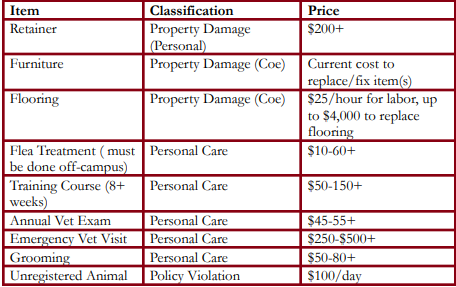
Item
Classification
Price
Retainer
Property Damage (Personal)
$200+
Furniture
Property Damage (Coe)
Current cost to replace/fix item(s)
Flooring
Property Damage (Coe)
$25/hour for labor, up to $4,000 to replace flooring
Flea Treatment ( must be done off-campus)
Personal Care
$10-60+
Training Course (8+ weeks)
Personal Care
$50-150+
Annual Vet Exam
Personal Care
$45-55+
Emergency Vet Visit
Personal Care
$250-$500+
Grooming
Personal Care
$50-80+
Unregistered Animal
Policy Violation
$100/day
 
Examples of past issues experienced by ESA handlers at Coe:
  • Roommate’s retainer chewed by handler’s ESA. Handler paid $200 and moved out of the room.
  • ESA chewed items purchased by roommate. Handler reimbursed roommate and moved out of the room.
  • ESA continually urinated in the room when the handler was absent. Handler required to take ESA off-campus.
  • ESA urinated in several locations in an apartment causing $3200 in damage that was billed to the handler. 
Confidentiality and Authority with ESAs 
Information regarding disability is considered highly confidential, is maintained in separate, secure files with limited access, and is only shared on a need-to-know basis. Authorizations for animals used for disability related accommodations are made based on medical and/or mental health documentation and the situation at hand, and are not subject to challenge by someone other than the person utilizing the service or ESA.
 

A student in need of academic accommodations, can schedule an appointment with the Accessibility Services Coordinator to discuss their experience and the accommodations they are seeking.
 
For more information, visit the Office of Accessibility Services webpage.

Dining together fosters connections between residents and the campus community. Coe College Dining Services provides a wide variety of food options to meet each student's individual needs. It may, however, be necessary for students to request special meal plan accommodations in certain situations.
 
Occasionally, students have special dietary needs and require accommodation to the meal plan for religious reasons. In many cases, Coe College Dining Services can meet these needs. It is rare for a student to be exempt from the meal plan. Exemptions are considered only for documented health conditions that require special diets that Coe College Dining Services is unable to accommodate.
 
There may be students who observe a religious practice that impacts their diet which Coe College Dining Services may not be able to fully accommodate. Students who fall into this category would be eligible for reductions in their meal plans or part of their meal plans.
 
Requests for Meal Plan Accommodations
Meal plan accommodations are available for residents with medical accommodations that require a special diet or religion-related dietary restrictions that cannot be fully met by Coe College Dining Services.
 
A student seeking a meal plan accommodation due to a medical condition should contact the Office of Accessibility Services to discuss their accommodation request.
 
A student seeking a meal plan accommodation based on the dietary requirements of the student’s religion should complete the Religion-Based Dietary Accommodation Form.
 
When requesting accommodations for meal plans, please note the following:
  • Students must request meal plan accommodations within the first week of each semester (except in cases of documented medical disabilities that require disability accommodation).
  • No meal plan accommodations are based on vegetarianism or veganism. Vegetarian and vegan options are available for every meal according to the dietary requirements of vegetarians and vegans.
  • A meal plan accommodation cannot be justified by financial hardship. Students should contact the Office of Financial Aid with any financial inquiries.
  • Meal plans will not be exempt for students who live in the residence halls without kitchens.
  • Meal plan accommodation requests are not guaranteed. Decisions will be made on a case-by-case basis with review of the Exemptions Committee. Any submissions after the set deadline will not be heard until the following semester.
Meal plan accommodations are not guaranteed. Decisions will be made on a case-by-case basis. A student whose request for a religion-based meal plan accommodation is denied may appeal the decision based on one or more of the following grounds:
  1. The outcome has been adversely affected by a procedural error (e.g., material deviation from established procedures). It is necessary to describe this error in the letter requesting an appeal. The decision will not be invalidated by minor or harmless deviations from the process; or
  2. New information may impact the outcome that was not available when the original request was made. It is essential to include in the appeal request a summary of this new information, why it was previously unavailable, as well as its potential impact on the decision.
Within five (5) business days of receiving notification of the denial of a meal plan accommodation request, an appeal must be submitted in writing to the Dean of Student Life & Co-Curricular Programs. The original decision will become final if an appeal is not requested within the specified time period.
 
The appeal will be considered by the Dean of Student Life & Co-Curricular Programs. As described above, the appeal will proceed if it is  determined that the appeal establishes adequate grounds for a review of the meal plan accommodation request. If clarification or additional information is needed to reach a decision, the Dean of Student Life & Co-Curricular Programs may request it.
 
The outcome of the appeal will be communicated in writing to the student, usually within five (5) business days of receiving the appeal request. In all cases, the appeal decision is final.

Student Support & Belonging

We at Coe College believe that everyone contributes to the enrichment of our community and enhances the educational experience for all students. Our mission is to create a welcoming and  supportive environment that embraces all people. This is not simply a goal, but an ongoing process that requires intentional effort and continuous improvement. In nurturing a welcoming community, we prepare our students to be responsible global citizens capable of navigating the complex challenges of the 21st century.
Student Support & Belonging at Coe College commits to:
  • Promote a campus culture that values and celebrates  belonging in all its forms.
  • Implement policies and practices that foster fairness for all members of the college community.
  • Provide resources, support, and programming to empower students, faculty, and staff to succeed academically and professionally.
  • Collaborate with campus departments and student organizations to organize events, workshops, and initiatives that promote awareness, understanding, and dialogue around community issues.
  • Conduct ongoing research and assessment to identify areas for improvement and measure the effectiveness of our efforts.
  • Foster a safe and respectful environment that encourages open communication and fosters a sense of belonging for everyone.
  • Actively engage with local communities and organizations to build bridges and promote relationships beyond the campus borders.
Through these endeavors, Student Belonging and Support at Coe College aims to create a transformative educational experience that prepares our students to be compassionate, globally-minded citizens and leaders in an increasingly interconnected world.

Bias Incident Policy

At Coe College, we place a high value on fostering freedom of expression and promoting an open exchange of ideas. While this commitment ensures the free expression of controversial viewpoints, it is essential to acknowledge that certain actions or expressions may have adverse effects on individuals or groups. A bias-related incident pertains to conduct, encompassing acts, behaviors, or communications against a member of the Coe community because of their real or perceived age, disability, ethnicity, gender, gender identity/expression, national origin/nationality, race, religion, sex, pregnancy, sexual orientation, veteran status, or any other legally protected class. Such acts, behaviors, conduct, or communications may contribute to an unwelcoming environment.
 
Understanding Bias 
This policy encompasses  both bias related incidents and hate crimes. 
  • Hate crime constitutes a criminal offense committed against individuals, groups, or property, primarily motivated by the offender's biases relating to disability, ethnicity, gender, gender identity, race, religion, or sexual orientation. 
  • Bias incident involves non-criminal actions, speech, or expressions driven, in part or whole, by a known or unknown bias or prejudice against individuals or groups based on their perceived or actual characteristics. 
Coe highly values the exchange of ideas and the free expression of differing viewpoints. While we encourage open discourse, it is essential to understand that ideas, perspectives, or behaviors that may be deemed offensive, insulting, controversial, or inflammatory do not automatically classify as bias-related incidents or hate crimes. 
 
However, it is crucial to reiterate that our commitment to openness and free expression does not extend protection to harassment or expressions of bias or hate based on protected class. These actions are not tolerated within the Coe community.
 

Reporting a Bias Incident 

If any member of the Coe community believes that another member of the community has violated the bias policy, they may file a report. Reports can be made online or in person to the Dean of Student Life & Co-Curricular Programs or their designees.
 
Even when the perpetrators are unknown or challenging to identify, such as in cases of anonymous graffiti or unwitnessed incidents, or when uncertainty exists regarding whether a policy or law violation has occurred, we strongly encourage reporting each instance or suspected incident. This documentation helps in recognizing patterns that could aid in identifying those responsible or providing enhanced support to individuals or communities affected by such incidents. 
 
Reports can be submitted anonymously; however, we ask that reporters provide their name and contact information, so that Coe College personnel can connect to offer resources and support, as well as seek additional information. Being able to follow-up with reporters puts Coe College personnel in the best position to provide an effective response. Upon receiving a bias report, the Dean of Student Life & Co-Curricular programs will promptly acknowledge its receipts. Subsequently, the Dean of Student Life & Co-Curricular Programs or their designee will conduct a thorough review of the report and extend the following to the reporting individual: 
  • Confirmation that the bias report has been duly received and recorded. 
  • Provide the reporter with an opportunity to meet to discuss the incident in greater detail. 
  • Support and resources will be shared to assist the reporting individual during this process. 
  • Notice of options, including, but not limited to the list below, if deemed appropriate. 
    • Evaluation: The Dean of Student Life & Co-Curricular Programs or their designee may initiate dialogue with the individual who is alleged to have engaged in the bias incident, aiming to gain a comprehensive understanding of the matter. Possible follow-up actions includes, but is not limited to:
    • Facilitated Dialogue: In certain instances, the Dean of Student Life & Co-Curricular Programs or their designee may facilitate a voluntary conversation between the reporting individual and the individual implicated in the bias incident. Importantly, physical meetings will not be obligatory in such cases.​​​​​​​
    • Educational Programming: The Dean of Student Life & Co-Curricular Programs or their designee may offer voluntary participation in training sessions or the provision of educational resources to those involved in the bias incident. ​​​​​​​
    • Restorative Practices: When both the reporting individual and the individual allegedly involved in the bias incident express an interest, trained community members may be assigned to facilitate the application of restorative practices. These practices serve to promote healing and mutual understanding in the aftermath of a bias incident. ​​​​​​​
    • Referral to Student Conduct Process: Should the reported action be indicative of a violation of college policies, the incident can be referred to the student conduct process.​​​​​​​
    • College Responses: Depending on the nature of the incident, the college may undertake necessary actions, such as the removal of graffiti, issuing community notices, and providing supportive resources and assistance to impacted communities. ​​​​​​​
    • No Further Action: After a thorough evaluation, it may be determined that no further action is warranted. The Dean of Student Life & Co-Curricular programs or their designee will diligently examine the reported conduct to ensure that any additional measures are unnecessary. 

Support & Resources 

We recognize that experiencing or witnessing a bias or hate incident can have significant physical and emotional repercussions. Any community member that has been impacted by such an incident is encouraged to report.
 
Reporting may not be the immediate preference for everyone, so the college also offers several resources to provide the community  with the support that may be needed.
Office Name
Contact Information
Campus Safety & Security 
Upper Gage, 212 
(319) 399-8888
Chaplain 
Upper Gage, Student Life Suite
(319) 399-8843
Mental Health & Counseling Services
Upper Gage, Student Life Suite 
(319) 399-8843
Office of Human Resources 
Voorhees, 1st Floor
(319) 399-8643
 

Considerations 

At Coe College, we recognize that not all offensive acts will be considered discriminatory conduct and a violation of our College  policies. Our institution highly values the principles of freedom of inquiry, thought, and expression, which are essential in nurturing a community of scholars. Determining whether a specific incident constitutes harassment, as outlined by our college policy is approached on a case-by-case basis, such incidents are diligently documented and tracked to achieve the following objectives: 
 
Support for the Affected:  offer necessary support services to those targeted by bias or hate, catering to their specific needs upon request. 
 
Monitoring for Patterns: detect emerging patterns of biased or hateful activity on campus and within the larger community, ensuring proactive responses. 
 
Recommendations for Prevention: recommend to campus leadership to prevent future bias/hate incidents through proactive measures. 
 
Given the unique nature of these incidents, students, faculty, and staff across various Coe College departments, programs, and organizations may be consulted to ensure the most informed and effective response to each report of a bias/hate incident. 
 
While the First Amendment protects free speech, it is essential to clarify that individuals who commit acts of bias or hate that are not protected under this amendment may face disciplinary action or legal prosecution. Examples of such acts may include physical assault, vandalism, intimidating comments or messages, defacing of posters or signs, trespassing, harassment, incitement, or genuine threats of violence. At Coe, we remain committed to creating a safe and inclusive environment, and we take decisive measures to address and prevent actions that harm our community's well-being.
 
Retaliation
Coe College strictly prohibits retaliation against any individual who makes a good faith report of bias incidents or participates in any related processes. Retaliatory acts will be subject to the student conduct or employee accountability process.​​​​​​​​​​​​​

Academics

The Academic Dishonesty Policy is a separate process from the Student Conduct process.  To learn more, visit the Provost’s webpage.
 
For the most up to date information regarding add/drop dates, registration, finals, etc. Please view the most up to date Academic Calendar.

The Coe College Office of Financial Aid has staff members who can assist in understanding your financial aid, budgeting your resources and loan management. Students are encouraged to contact the office when in need of assistance. The office can be reached by calling 1.877.CALL.COE or 399-8540 (locally) or via email at o-financialaid@coe.edu to schedule an appointment. The Office of Financial Aid is located on the first level of Voorhees Hall. The office is open from 8 a.m. - 4:30 p.m. Monday-Friday during the school year. The office closes at 2 PM on Fridays during the summer.
 
Coe College provides comprehensive need-based and merit-based financial aid programs designed to help qualified students attend Coe regardless of their family financial situation. These assistance programs are based on the premise that students and parents should pay for college to the extent that they are able. Need-based financial aid is used to help make up the difference between the cost of college and what a family can afford.
 
Reference the Financial Aid Handbook for information on specific financial aid programs administered by Coe and other financial aid topics.

Students exiting the college should start the process by scheduling an exit interview with the Dean of Student Success and Persistence, Lauren Garcia-Pastorek at lgarciapastorek@coe.edu or 319.399.8242. At the interview, the student is given an official exit checklist that provides information that students should review before departing campus. Students may need to also meet with other campus departments, including:
  • The Student Financial Services Office, to verify a balance due or a credit to be refunded, as well as Student Loan information, and to be aware of financial aid adjustments;
  • The Library, to ascertain that all materials have been returned;
  • The Director of Residence Life, to arrange for room checkout within 48 hours.
All exiting students will also be asked to complete an exit survey, which can be completed electronically after the exit interview.
 
Visit the webpage for the Business Office for additional exit resources and information.​​

General Campus Resources

The Health & Wellness Office seeks to maximize student well-being by helping students reach their full potential. The office helps students minimize harmful behaviors while teaching students skills that promote healthy living. This is accomplished through offering; meditation, counseling, sleep programs, fitness classes and many other opportunities that promote growth across all dimensions of wellness.
 
Counseling Services
Office Location: Upper Gage Memorial Union, Student Life Office
Office Phone: 319-399-8843
Office Email: wellness@coe.edu
 
Coe offers some free, short-term options for mental health and counseling. Our staff can also help students get connected with community resources for longer term or specialized care.
 
Appointments available: Monday -Friday from 8am-4:30 pm. If students are in need of crisis care outside of business hours, please call campus security at 319.388.8888.
 
*To request an appointment with a Coe College mental health counselor on campus, please schedule online
 
Crisis Services/Crisis Stabilization
If students need to speak with someone immediately or in case of this is an emergency the following resources are available:
  • If students are on campus, contact Campus Safety & Security at 319.399.8888. (available 24/7)
  • Call Foundation 2, Mobile Crisis Services at 319.362.2174 or 800.332.4224 (available 24/7)
    • Crisis text Foundation 2: 800.332.4224 (available M-F 9am-3pm)
    • Crisis chat Foundation 2: chat link (available M-F 9am-3pm)
  • Linn Co. Mental Health Access Center.
    • Location: 501 13th St. NW, Cedar Rapids (walk-in, no appointment necessary)
  • Call or text 988, National Suicide and Crisis Lifeline (available 24/7)
  • Go to the emergency room or call 911. (available 24/7)

Location: Lower P.U.B.
Office Phone: 319-399-8617
Office Fax: 319-399-8269
Office Email: o-healthservices@coe.edu
 
Office Hours & Appointment Availability: 
  • Appointments with our contracted Physician Assistant (PA) are available Monday-Friday from 1:30-3:30 p.m. during the academic year
  • Closed on college holidays, breaks and summer. 
  • Based on the specific request/need, walk-in students may be immediately referred to a local urgent care or hospital, seen in Health Services, or given a scheduled appointment for a later time
Appointments can be scheduled online.
 
About Health Services
Coe College Health Services is a comprehensive outpatient clinic which can meet most basic health needs of students. Medical problems that go beyond the scope of the Health Services Staff are referred to appropriate off‐campus facilities and are not covered by Coe College. Health Services is staffed by a licensed Physician Assistant (PA) contracted through Mercy Medical Center in Cedar Rapids, and the Assistant Dean of Health & Wellness.
 
With a few exceptions, all of the services performed in Coe’s Health Services are free to all Coe College students (including part-time, commuter, and non-traditional students). The student’s insurance and/or self-pay is utilized when the student seeks healthcare elsewhere, such as other specialty physician visits, walk‐ins, urgent care visits, the emergency room, lab testing, x-rays, and prescription medication. Additional information can be found on the Health Services website.
 
Health Services Provides 
  • Assessment, evaluation, diagnosis, and treatment of minor illness and injury
  • Diagnostic tests (e.g. strep screen, COVID-19 test, mono test, urinalysis, pregnancy, )
  • Sexual health education (contraceptive counseling, pregnancy and sexually transmitted infections testing, and emergency contraception)
  • Prescriptions for medications, when appropriate
  • Additional/seasonal vaccination clinics including, but not limited to those for influenza and COVID-19 
  • Physical exams for uninsured/underinsured students 
  • Free health promotion and reference materials on a variety of health topics (weight reduction, nutrition, smoking cessation, fitness, and stress reduction counseling)  
  • Health and wellness promotion/programming 
  • Medical referrals as necessary for ongoing or specialty care
  • Assistance with understanding/obtaining health care coverage
If x-ray or other imaging studies are indicated, students will be referred  off-campus . Students must take insurance cards and/or other self-pay options. These services are not paid for by Coe College. 
 
For night or weekend emergencies, students should seek treatment at one of the local emergency rooms or urgent care centers. A list of off-campus after-hours/emergency resources can be found online.
 
Medications and Health Care Supplies 
A limited selection of over‐the‐counter medications such as throat lozenges, decongestants, antihistamines, acetaminophen, ibuprofen, antibiotic ointment, and antacids are available in Health Services in addition to surgical masks, bandages, hand sanitizer, menstrual products, hot/cold packs, and soaking basins. Condoms, dental dams, and lubrication are also available to all students, free of charge. Crutches and wheelchairs are available through a free check-out process. Please note, selection and supplies may not meet all student needs. For ongoing supplies and products, students are encouraged to keep and supply personal health kits to meet individual needs.
 
Prescription Medications 
Students should bring an adequate supply of their prescription medication. For controlled substances (ADHD medications, anti‐anxiety medications, etc.), it is highly recommended that the student obtain a lock box for storage of these medications. Prescriptions written for students by Health Services staff can be filled at any pharmacy in the area.
 
Hospitalization 
If a student should require hospitalization, these costs are not covered by Coe College. Each student is responsible for their own expenses for care.
 
Parents are notified of the hospitalization of a student by the college if the student is under 18 years of age, is unconscious/incapacitated, or gives their consent for such notification. Parents are not notified of a student’s hospitalization by the college if the student is over 18 years of age and does not wish for parent notification. Students are highly encouraged to communicate with parents/ family in the case of hospitalization or other emergency care.
 
Insurance
Coe College does not offer medical health insurance policies for domestic students. Students should review their individual insurance plan to be certain they have coverage in the Cedar Rapids area and know the procedures for utilizing insurance. Students with out of state or out of network insurance coverage are encouraged to call the insurance provider’s customer service number to see what coverage is available in the area. Some plans allow for in-network coverage or reduced fees for out of state students enrolled full time.
 
All students should carry some form of medical insurance. Students without health insurance or that are underinsured, may have options for free or sliding fee scale services. For assistance in obtaining or understanding private or public insurance plans available, call or email Health and Wellness staff at wellness@coe.edu or 319-399-8843.
 
Confidentiality 
All health records are maintained strictly confidential.. Information is released only when a student’s permission is given by written consent, including to parents/guardians with the exception of the following:
  • Under 18 years of age:  According to Iowa law, students that are 17 years or younger, must receive permission from parent(s) or legal guardian(s) to receive medical care, treatment, or services, and they have the legal right to be informed about treatment. However, Iowa law also states that students under the age of 18 do not require parental/legal guardian consent for the following health care services: contraceptive services, emergency care, HIV/AIDS care, non-medical services, sexually transmitted infection services, substance abuse treatment, tobacco cessation services, sexual abuse or assault related medical and mental health services.
  • Suicidality/homicidality/other physical harm to a third person: When there is a reasonable suspicion or evidence that a student is at imminent risk of attempting or completing suicide or homicide or physically harm another person, or if the student describes themself to health and wellness staff as being at such risk, Coe College will take action to protect the student’s safety and the safety of others. In these circumstances and/or in situations where the health and wellness staff member is obligated to seek outside assistance, student privacy will be maintained to the extent possible.  Sometimes this will require breaking confidentiality.
  • Emergency care: If emergency medical or mental health care is needed, Coe College will provide relevant information about the student to those involved in accessing and providing the student’s care.
  • Compelling professional reasons including but not limited to; reports of child, elder or dependent adult abuse.
Special Health Needs 
If at any time a student would like to review the contents of their medical records, contact Health Services staff.
 
Students are encouraged to inform Health Services of any special health condition or needs. If desired, consider informing roommate(s) and/or Resident Assistant of health needs (e.g., diabetes, seizures, asthma, etc.). Students needing accommodations for a health condition should reach out directly to the Accessibility Office within the Learning Commons.
 
Dietary Restrictions & Other Needs  
Provisions can be made through Sodexo Food Service for students who have dietary restrictions. Students may also call Sodexo Food Service at 319-399-8648. 
 

Health Related Policies

 
Class Excuse Policy 
Coe College Health Services does not provide students with medical excuses for short-term absences from classes, labs, athletic events, college performances, exams or any sort of deadline due to illness, injury, or appointments in Health Services. This policy, which has been in place since 2011, not only frees up staff time and appointment slots for those in need, but it also places the responsibility of communication in the hands of students.
 
Students should contact their professor(s), coach(es), or supervisor(s) directly concerning short-term absences. In the event of a long-term illness/injury, students may choose to communicate with Accessibility Services to receive appropriate documentation regarding absences.
 
Immunization Policy 
Per Iowa law, all students are required to have an immunization record on file with Health Services prior to the first day of classes. Class registration for subsequent semesters will be held if an immunization record is not submitted.  For a list of required and recommended immunizations, please visit the Health Services website.
 
Rights & Responsibilities as a Patient
Members of the Coe College Health Services staff strongly believe that each person is entitled to certain rights as a patient of Health Services. In addition, each patient has certain responsibilities. Together, these ensure that each individual receives appropriate medical care and personal service. 
 
Each Health Services patient has the right to: 
  • Access care and treatment regardless of race, creed, sex, national origin, or sexual orientation
  • Consideration and respect for personal dignity and privacy.
  • Know and identify the health care professionals providing the service. 
  • Expect that their diagnosis, prognosis and methods of treatment be explained clearly and in terms that they can understand. 
  • Clear and concise explanations of their condition and of all proposed procedures, including the risks and possible problems or side effects that may result. 
  • Refuse treatment to the extent permitted by law. 
  • Be informed about Health Service regulations and policies governing their conduct as a patient.
  • Know what alternatives exist for their care and treatment.
  • Seek medical treatment off campus at their expense. 
  • Consult with a specialist at their expense. 
Each Health Services patient has the responsibility to: 
  • Provide, to the best of their knowledge, accurate information relating to health matters. 
  • Follow the treatment plan recommended by those primarily responsible for their care. 
  • Accept personal responsibility if they refuse treatment. 
  • Know and abide by Health Services regulations and policies during their time at the clinic. 
  • Assume financial obligations for services received over and above basic on campus health services.
  • Respect the rights of other patients, Health Services personnel and others they may come in contact with. 
General Information  
Medical Records
A medical record is maintained on all students. Medical records are kept for 5 years from the date of graduation. If the student needs medical records transferred, a written release is required. 
 
Wellness Programs 
Health and Wellness staff coordinates a variety of wellness events and activities throughout the year and work closely with other professionals in health promotion and establishing or maintaining healthier habits including but not limited to: stress reduction, effective coping mechanisms, healthier relationships, sleep habits, etc.

The operational unit of the College directly charged with providing campus security services is formally designated as the Safety & Security Department.
 
Personnel assigned to this department are known as security officers. The department shall have a minimum complement of two security “lead” officers and four security officers. “Lead” officers will be Coe College staff positions, while the remaining officers will be a mix of staff and contracted security (PerMar Security Services).
 
The Security Department is charged with first line responsibility to:
  • Assure the safety of persons, including College employees and students, guest of and visitors to the campus;
  • Assure the safety, security, and protection of College property, including buildings, grounds, equipment, and other assets of the College, as well as non-college property located temporarily or permanently on College grounds;
  • Respond to emergency situations or conditions and provide aid or take actions appropriate to the crisis situation within legal limits of the department's authority.
Basic Duties
In fulfilling these three primary responsibilities (protection of persons, protection of property, and emergency-response services), the duties of security officers include, but are not limited to, the following:
  • Patrolling campus grounds, either on foot or in an authorized College vehicle;
  • Conducting regular checks and inspections to insure building safety and security;
  • Reporting damage, malfunctions, faulty equipment or utilities, or any unusual or questionable or dangerous or suspicious conditions or activities anywhere on campus, indoors or outdoors;
  • Assisting all persons to comply with College regulations and rules of conduct on campus, including issuing traffic and parking citations when appropriate;
  • Providing security coverage for special College functions as assigned by a direct-line supervisor;
  • Providing crowd control when necessary and as assigned by a direct-line supervisor;
  • Responding to requests for routine departmental services (e.g., unlocking a classroom for a person authorized to enter, walking escorts, assisting in starting cars with dead batteries, etc..).
  • Enters each dormitory only as directed or on a need basis
Basic Authority and Limits
Citations:
Security officers are authorized by the college to issue written citations for parking violations and moving violations. Such citations may be issued to any person, employee or non- employee, student or nonstudent, who violates traffic or parking regulation on college property; and violators receiving such citations are subject to fines or other disciplinary actions by the College as specified in College regulations.
 
Vehicle without Coe College parking permits that are parked on campus or in no-parking areas (in handicapped slots, in loading zones, beside fire hydrants, on grass, on sidewalks, in reserved parking areas, etc.) shall normally have a parking citation issued and be subject to being towed at the owner’s expense.
 
Identification Requests:
Security officers are authorized to request to see the identification of any person on campus property, whether that person is an employee or non-employee, student or non-student. Any College employee or student who refuses to comply with a security officer's request for identification is subject to disciplinary action by the College. And or involvement of Cedar Rapids Police
 
Contact and Reporting:
Campus Security is available 24/7 by calling 319.399.8888. The Coe Community are encouraged to download the Coe Safe App by App Armor on their smartphones.  For more information visit the Safety and Security webpage.

All student organizations must be registered approved by the Office of Campus Life before they are able to access the following resources:
  • Reserving non-academic and academic spaces for meetings and events
  • Request funding from Student Senate
  • Have a business account to hold funds
  • Receive a Coe-approved club email address
  • Host and manage organization page in the involvement app

Additionally, all student clubs and organizations must re-register annually with the Student Activities office to maintain these benefits. Re-registration occurs at the start of every academic year.

Students who are looking to join an existing organization or have questions about starting their own organization, can reach out to studentactivities@coe.edu.

Student organizations are expected to adhere to all college policies, and are subject to the Student Conduct Process for Organizations.  For more information visit the Accountability for Student Organizations & Groups webpage.

The Office of Student Success & Persistence helps first-year students navigate their transition to college by connecting students to the people, tools and resources needed for success. Every new first-year student will be assigned a Success Coach, who is here to help students become more familiar with resources on-campus and in the Cedar Rapids community.
 
Success Coaches provide proactive outreach via text and email to help students become aware of important information and resources commonly utilized during the first year. Through programming efforts like Orientation and Connect 4 events, Success Coaches thoughtfully create avenues for students to interact with members of the Coe community that will help them achieve their goals.
 
Success Coaches are located on the main level of Stewart Memorial Library and are available by appointment but welcome drop-in appointments as well. For further information, email studentsuccess@coe.edu.

The Learning Commons is located on the main and lower levels of the Stewart Memorial Library.  Services include tutoring, executive function coaching, Supplemental Instruction, the Writing Center, Accessibility Services, and the Testing Center.
 
Visit the Learning Commons webpage or email at learningcommons@coe.edu to learn more.

Creativity, Careers, Community (C3) assists students across a range of topics related to their professional and personal development during their time at Coe. Students receive guidance on a range of topics including skills assessments, career exploration and development, resumes and cover letters, interviewing, networking, and internships/job searching. Students are matched with a Career Specialist based on their interest, major, and/or potential career industry to receive tailored advice and guidance. C3 also provides leadership and community engagement opportunities including the BOLD Program (Board Orientation and Leadership Development), organizations that accept volunteers, and administers Coe's Off Campus Federal Work Study Program which enables students to work in the community while earning part of their financial aid package. Finally, C3 also assists all students with non-partisan voter registration while working directly with CoeVotes, a student-led voter registration club.  All students are encouraged to visit with a C3 Career Specialist at least once per term to discuss their individual development and consider next steps.
 
Students can make an appointment with a Career Specialist by using Handshake (found on my.coe.edu), calling x8260, emailing o-career@coe.edu, or visiting C3 in McCabe Hall.

Coe College Athletics Philosophy Statement
Coe College athletic programs prioritize the enhancement of the overall educational experience and support the successful completion of all student academic pursuits. Coe College seeks to establish and maintain an environment in which student- athlete athletic activities are conducted as an integral part of the educational experience, while establishing and maintaining an environment that values cultural diversity and gender equity among its student-athletes and athletic staff.
 
Primary Health Insurance/Physical Policy
Prior to practice or play as a member of an intercollegiate team, every student athlete at Coe College must meet the following guidelines:
  • Have a record of physical examination on file with Coe College. Freshmen and transfers must have completed a physical examination during the six months prior to enrolling at Coe.
  • Complete a Demographics and Mandatory Verification of Medical Insurance form. Every student-athlete at Coe is required to have their medical insurance meet the listed requirements on this form. One of the requirements is to ensure that student athletes have enough insurance to meet the NCAA provided catastrophic insurance policy. The NCAA provides catastrophic insurance coverage to all NCAA student athletes in the event that an injury or illness exceeds $90,000. In addition to completing this information each student athlete will be required to submit a copy of their insurance card. This will be placed on file in the event that medical assistance is needed.
Reference the Student Athlete Handbook for more information on Coe College Athletics staff, resources, eligibility, expectations, and policies.

Miscellaneous

Residential living is central to the learning environment for all Coe College students and it's what makes Coe a special place. Therefore, we require all full-time students to live on campus for four years (and purchase a meal plan if their building requires it).
 
The only exceptions to the four-year residency requirement are:
  1. Students who are living at home with a parent/legal guardian within 25 miles of Coe (verification required) 
    1. Cannot be a relative such as sibling, aunt/uncle, cousin, or grandparent (unless legally documented as legal guardian).
    2. Must be able to establish residency at the address for at least one year.
    3. Must be the parent/legal guardian primary residence.  Parents/legal guardians cannot purchase a house for their student to live in.
  2. Students who are 23 years of age or older by the first day of class of the current academic year (verify age through records in Symplicity).
  3. Students who are married by the first day of class of the current semester (a copy of marriage license must be provided).
  4. Students who have a dependent child living with them (verify through child’s birth certificate or legal documents of legal guardian change).
    1. Students who are expecting to give birth in the middle of the semester.
  5. Students who have completed living on campus for 8 full semesters.
  6. Students who are enrolled less than full-time
If a student believes they meet one of these exceptions, they must complete the application, available in Residence by Symplicity
 
Applications will be reviewed on a block basis:
  • Spring Submission/Review Period: Thanksgiving Break - Spring Date of Record
  • Fall Submission/Review Period: March - Fall Date of Record
Applications submitted after the Date of Record (DOR) are liable to pay housing & meal plan fees. The Off-Campus Housing Committee will make determinations about requests, and students will be notified via email if their request has been approved.
 
Students residing with their parents while commuting are certifying the accuracy of this living arrangement. Providing false information to the college constitutes a violation of the housing contract and students will be held responsible.
 
Approval to live off-campus is only for the current academic year and doesn't guarantee approval for any subsequent year (students must re-apply for subsequent years).
Students who violate the residency requirement will be charged full room & board costs for the entire year
 
Coe College strongly encourages students not to sign off-campus leases until it is confirmed that the request has been approved. A signed lease will not result in approval.​​​​

Photographs, video and recordings may be taken by the college or its designees in public areas of the Coe College campus and at off-campus college events. The College may use such photographs, video and recordings to document, promote and provide information about the college and its programs without prior consent by individuals depicted or recorded in them. Public areas include but are not limited to outdoor areas, classrooms, laboratories, athletic and recreation facilities, residential living space common areas, dining facilities, lounge areas, meeting rooms, and performance spaces. 
 
A student has the right to refuse to permit release of any or all information about their likeness, and/or the use of their image or voice (if clearly identifiable in photographic, video or recording), without the student’s prior written consent. Any refusal must be received in writing by the Marketing Office (marketing@coe.edu) prior to date of record at the start of the academic year and designate the information not to be released in new materials in the future.
 
Prior refusal of permission to release a student's likeness and/or use of image or voice via the mandatory forms on My Coe will be honored.

Downloadable PDF version of Student Handbook