
Three degrees in six years: Shaping engineering futures through shared strengths
 Two powerhouses in the physics and engineering fields have entered into a dual degree agreement. Coe College students can now pursue an additional bachelor’s degree and master’s degree in engineering with Washington University in St. Louis at an accelerated pace.
The 3+3 engineering dual degree program will pave the path for Kohawks to earn three degrees in six years when a student would normally earn two degrees in the same time period.
Students who choose the dual degree program will spend their first three years at Coe completing general education coursework along with courses in the college’s engineering physics major. Then, if the student meets coursework, GPA and review requirements, they can transfer into the James McKelvey School of Engineering at Washington University to pursue degrees in a specific engineering field.
“Our engineering physics program provides the science foundation for nearly any engineering field,” explained Fran Allison and Francis Halpin Professor of Physics Mario Affatigato ’89. “This dual degree agreement is particularly helpful to students who know the specific engineering field they want to join. They can move directly into the 3+3 program at Washington University in St. Louis and earn a bachelor’s degree in engineering physics from Coe, a bachelor’s degree in their specific engineering field from Washington University and then a master’s degree in that engineering field.”
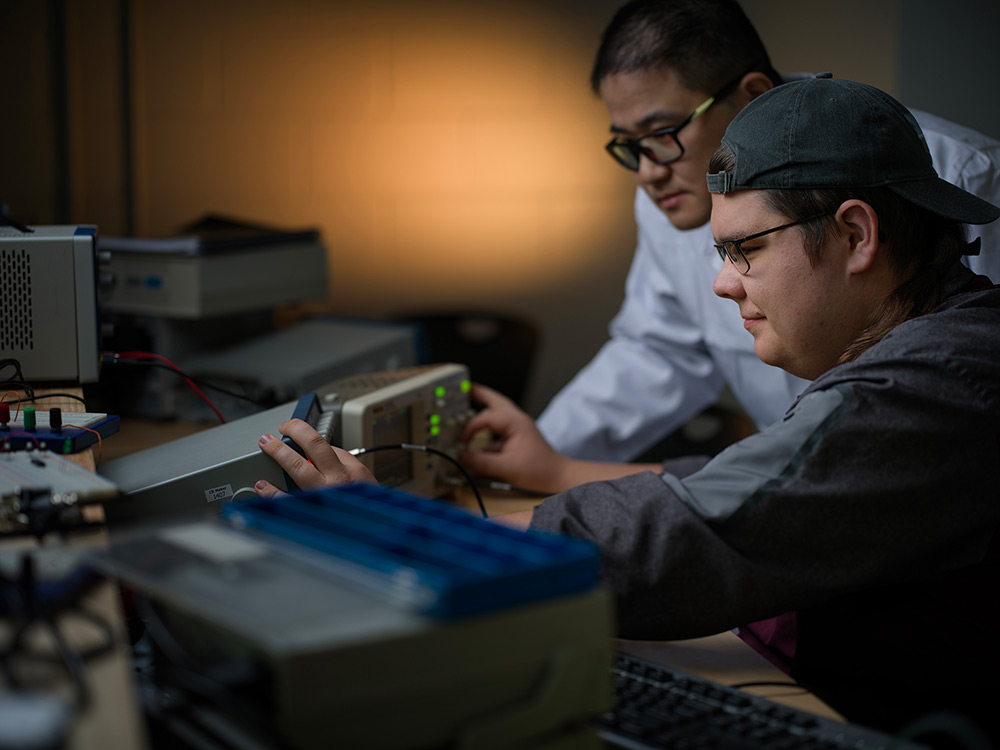 Admission into the McKelvey School of Engineering is guaranteed under the agreement if students meet the specific criteria.
“This is two powerhouse schools joining forces,” said Interim Vice President for Enrollment Josh Kite. “Both have incredible reputations in the science and engineering realms, so if you want an incredible engineering education, high-level connections and to stand out among job candidates because you have three degrees, starting your engineering degree at Coe is your best bet.”
The engineering physics program at Coe focuses on the science behind key engineering principles, creating well-rounded engineers and a pathway to a number of master’s programs. The program is led by internationally recognized physics faculty, including Affatigato who is the current president of the American Ceramics Society. It is a research-rich academic environment, which lays groundwork for master’s level coursework.
Since 1986, the department has received continuous research grants from the National Science Foundation (NSF). Additional funding has come from NASA, Department of Energy, the National Institute of Health and Fortune 500 companies. Coe is also a host site for the NSF’s Research Experiences for Undergraduates program — one of only a few small schools in the country to serve as a member of this prestigious program.