
Coe College assistant professor of biology helps uncover a crucial dino discovery
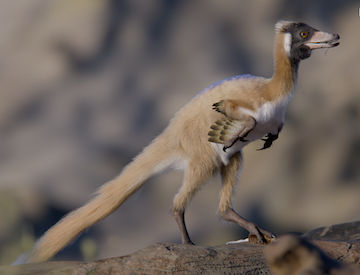 In the dusty expanse of Patagonia, Argentina, a discovery is rewriting dinosaur history. While many focus on prehistoric giants, a team of international scientists, including Coe College Assistant Professor of Biology Jon Mitchell, has turned the spotlight on a creature smaller than a house cat.
Mitchell, a leader in the paleontology field, is one of many faculty members at Coe who conduct research and publish in prestigious academic journals. This latest find is published in the scientific journal Nature.
The star of this discovery is Alnashetri cerropoliciensis, a miniature dinosaur that lived approximately 95 million years ago. Weighing under two pounds, Alnashetri is one of the smallest non-avian dinosaurs ever found in South America. For Mitchell and his colleagues, its completeness makes it a crucial scientific discovery.
For decades, bird-like dinosaurs known as alvarezsaurs were a mystery. Characterized by tiny teeth and stubby arms ending in a single large claw, they were well-documented in Asia but elusive in South America. Previous Southern Hemisphere finds were often too fragmented to interpret.
“This discovery was incredible because this nearly complete skeleton rewrote what we thought we knew of this group and let us look at specimens around the world with new eyes,” said Mitchell.
As a key member of this team, Mitchell contributed to the study published in the journal Nature in February. Their findings provide the "missing link" for this group, allowing scientists to map the strange anatomy and evolutionary transitions of these tiny predators, which likely survived on bugs and small animals.
The discovery challenges long-held beliefs about evolution. The team’s research suggests that miniaturization in this group wasn’t a single evolutionary event. Instead, it appears to have evolved multiple times independently across different lineages.
Recovered from the La Buitrera fossil area in northern Patagonia, the fossil required a decade of careful preparation. Mitchell’s involvement highlights Coe's commitment to global research. All Kohawks are guaranteed an internship, research opportunity or off-campus study before graduation.
Working with experts from both domestic and international universities and institutes, Mitchell helped prove these animals originated much earlier than expected — dating back to when continents were joined as Pangaea. The work continues, with the team already analyzing new fossils from the same site. Mitchell featured this discovery and his story uncovering it this past fall during one of his Thursday Forum sessions.