
Kopelman bringing weather to life for Kohawk aviation students
 There are two connecting points between the newest industry professional to teach a course at Coe and their subject. One is obvious, the other a dream that never came to fruition.
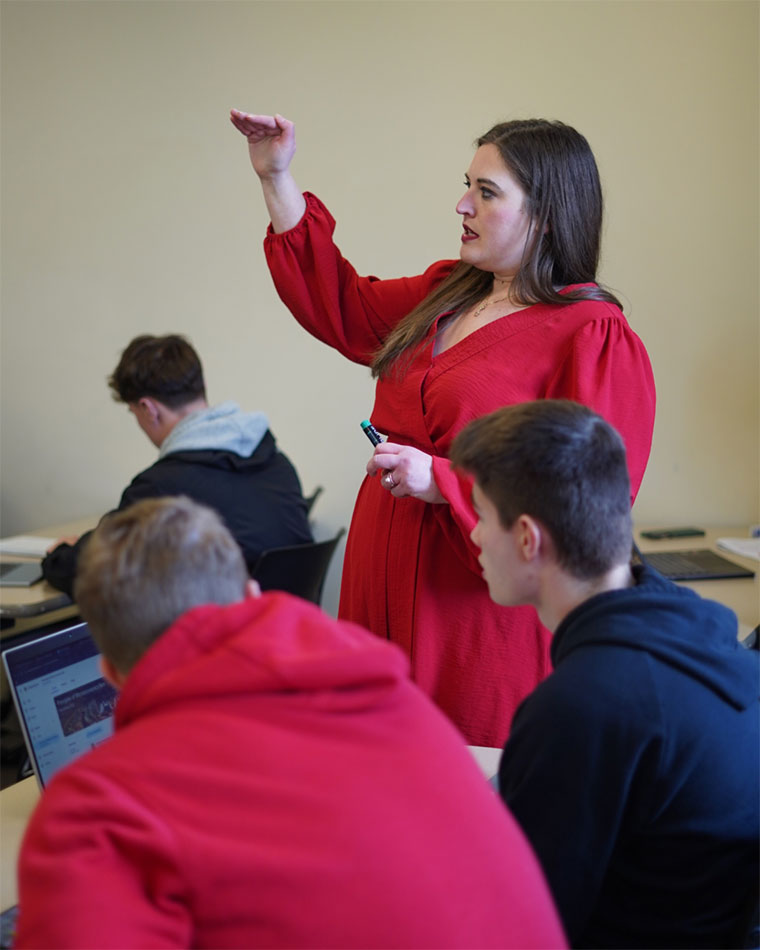
Rebecca Kopelman, chief meteorologist at the Iowa News Now television stations, is teaching Principles of Meteorology this term within Coe College’s aviation management & flight operations concentration.
Future pilots need to understand how the atmosphere functions and how weather develops — that’s the obvious connection. As a Florida native, Kopelman grew up dreaming of becoming a Hurricane Hunter, one of the pilots who willingly fly into the eyes of hurricanes to gather as much data for forecasting the monster storms’ paths as possible. So in a way, working directly with aviation students is a full-circle moment for Kopelman.
Today, however, she is focused on translating her wealth of weather knowledge into practical applications for future Kohawk pilots. Kopelman joins a growing list of working professionals in the greater Cedar Rapids area who are bringing their industry expertise directly into the classroom at Coe as Executives in Residence. Eastern Iowa Airport Director Marty Lenss and retired President & CEO of Mercy Medical Center Tim Charles have also led courses at Coe.
“I go to work and forecast the weather and then I come to campus to discuss that weather from an aviation angle. So I’m bringing real-time, real-world knowledge to help students connect the dots with what’s actually happening outside with why it’s important to them,” Kopelman said.
The college is intentionally inviting professionals to teach select courses to increase real-world viewpoints and practical industry knowledge and to help students build professional networks. The approach pays off for Kohawks as nearly 100% of reporting graduates are employed or in grad school within nine months of graduation.
“There are advantages for our students to get perspectives from working professionals,” said Coe College Provost Angela Ziskowski. “In addition to the foundational knowledge we build in the classroom, we want our students to understand the day-to-day know-how as well. With that level of practical knowledge, you have an advantage in going out and starting a career or being accepted into grad school.”
Ziskowski and Pam Carstens, professor of business administration and economics, contacted Kopelman looking for someone to teach the meteorology course. Kopelman asked herself, “Why not me?” and submitted her resume. She does the morning news and has afternoons free. The Coe faculty welcomed her, and business faculty have helped the first-time teacher develop a curriculum and get started. Coe faculty are the #18 Most Accessible Professors in the Nation, according to The Princeton Review, and Kopelman has fit right in.
To kick off her first course in January, Kopelman had her students complete a quick questionnaire. She was happy to see that since the course was just for aviation students, the class already had a base layer of knowledge and a thirst to build a proper weather foundation.
“Flying depends on the weather. Whether you can take off or land that day depends on conditions, so they want more depth and understanding in why weather events happen,” Kopelman said.
It’s a collaborative atmosphere in the classroom as Kopelman incorporates distinct aviation content into broader lessons. She talks about METARs and PIREPs — METARs (METeorological Aerodrome Reports) are standardized, hourly aviation weather reports used by pilots and meteorologists to determine current ground-level weather conditions at an airport and PIREPs (pilot reports) are reports of actual weather conditions encountered by an aircraft in flight, providing critical, real-time data on phenomena like turbulence, icing and cloud coverage.
Pilots will use aviation weather reports on a daily basis in their professional lives and Kopelman builds them into foundational weather lessons that are heavy in math, chemistry and physics, which are subjects that help explain how thermodynamics impacts the atmosphere.
The experience so far has been “cool,” according to Kopelman. Her students are engaged and even “fired up” about METARs. Their enthusiasm for learning about weather mirrors the passion that has driven her own career.
“It’s funny that my career has come back around to this aviation program,” Kopelman said. “But I love to mentor and I really enjoy being able to help these students grow their weather foundation and understand meteorology.”
Coe College’s aviation management & flight operations program is helping to close an estimated 17,000 pilot gap due to age-mandated retirements. The increase in demand for commercial pilots is driving starting salaries near $90,000 and Kohawks are able to start their flight training immediately in their first term on campus.
Operating out of Coe’s dedicated Aeronautical Field Station at the Eastern Iowa Airport (CID), Kohawk aviators pursue Part 141 flight training with seasoned flight instructors from ATD Flight Systems while working directly with air traffic control and a full commercial flight schedule to mimic realistic flying scenarios, which not all flight schools can offer. An internship at CID is reserved exclusively for a Coe student.